How Private Equity Firms Use Data Rooms to Manage Due Diligence

Artem Axelrod
Co-Founder @ Pageform | AI-native narrative data rooms for fundraising & deals

TL;DR: Private equity due diligence is systematic, multi-stakeholder, and document-heavy. The data room isn't just a file repository, it's the operational backbone of the entire process. The best PE teams use it to coordinate workstreams, track counterparty engagement, and surface bottlenecks before they become deal killers.

At Pageform, we've spent the last three years obsessing over data rooms and watching how deal teams actually work through them. Private equity due diligence is a different beast entirely compared to venture rounds, and the data room infrastructure supporting it needs to reflect that reality.
Why Private Equity Due Diligence Is Different
Venture investors might spend 30 minutes skimming a pitch deck and financials before making a decision. Private equity firms are acquiring proven businesses and need to verify every claim. That changes everything about how a data room gets used.
The differences that matter most:
Volume and complexity: PE buyers want 3-5 years of detailed financial statements, customer contracts, HR policies, legal documents, and operational metrics. This isn't a pitch deck situation.
Multiple stakeholders: PE deals involve investment teams, operations partners, legal counsel, accounting firms, and specialized consultants — each requiring different access levels to different document sets.
Extended timelines: Due diligence runs 60-120 days, not the 2-4 weeks typical in venture rounds. The data room needs to stay organized and functional throughout.
Regulatory requirements: Depending on industry and deal size, SOC 2 compliance, specific data residency, and detailed audit trails may be non-negotiable.
How Private Equity Firms Actually Work Through a Data Room
The best PE data rooms are organized around workstreams, not document types. Here is how the process typically unfolds:
Financial Due Diligence
The accounting team downloads historical P&Ls, balance sheets, cash flow statements, management reports, and detailed transaction data. They build their own models offline and upload questions back into the data room. Granular permissions matter here — PE firms often restrict which team members can access specific financial details.
Commercial Due Diligence
Operations partners dig into customer contracts, market analysis, competitive positioning, and growth projections. They are looking for post-acquisition risks and upside opportunities. This workstream generates the most back-and-forth questions.
Legal and Regulatory Review
External counsel reviews incorporation documents, material contracts, IP filings, employment agreements, and compliance records. They need bulk download capability for their own review systems and expect nothing to be missing.
Operational Assessment
PE firms want to understand systems, processes, and organizational structure. Org charts, key employee contracts, IT infrastructure documentation, and operational metrics all live here. This is often where gaps surface late in the process and deals slow down.
What Separates a Good PE Data Room from a Bad One
Most data rooms fail private equity due diligence teams in predictable ways:
Folder chaos: Documents organized by type rather than workstream force reviewers to hunt across sections to complete a single line of inquiry. Organize by workstream from day one.
No visibility into progress: Without section-level analytics, deal teams have no way to know which workstream is moving and where bottlenecks are forming. Knowing that legal has spent three hours in the contracts section but hasn't touched IP filings is actionable intelligence.
Poor permission architecture: Setting up permissions as an afterthought creates security gaps and slows the process when access needs to be adjusted mid-diligence. Plan the permission structure before the first document goes in.
Q&A at volume: PE diligence generates 100-300 questions on a typical deal. A data room without structured Q&A functionality turns into an email thread that nobody can manage.
Narrative gaps: Even in private equity, the story of the business matters. A data room that presents documents without context forces the buyer to construct their own narrative, which is rarely the one you want them to have.
What Pageform for Private Equity Does Differently
Pageform was built specifically around these failure points. The narrative canvas structures your data room by workstream from the start, so reviewers never hunt for documents. Section-level analytics show you exactly where each counterparty is spending time and what they are skipping. Built-in Q&A keeps all questions and responses inside the data room, not scattered across email threads. Permissions and NDA gating are configured before the first document goes in, not as an afterthought. And because every data room is built around a guided narrative, your buyers understand the story of the business, not just the files behind it.
What to Look for in a PE-Grade Data Room
Not all platforms are built for this level of deal complexity. The capabilities that matter most for private equity due diligence:
Section-level engagement analytics so you know what buyers are focused on
Granular, role-based permissions that can be configured before day one
Structured Q&A with document linking and threading
Bulk download support for offline analysis
Audit logs and access tracking for compliance
NDA gating before any documents are accessed
A narrative layer that guides reviewers through the material in the right order
Pageform was built to bring all of this together in a platform that is live in minutes, not days — without the $25,000 per deal price tag of legacy VDR providers.
The Bottom Line
Private equity due diligence is where deals are won or lost on execution, not just fundamentals. A well-structured data room that guides reviewers, tracks engagement, and surfaces gaps before they become problems is one of the highest-leverage things a deal team can control. The firms that treat their data room as a strategic asset rather than a document dump consistently run cleaner, faster processes.
We built Pageform to be is a narrative-driven virtual data room (VDR) for deal teams running private equity due diligence, LP raises, M&A, and real estate transactions. AI generation, section-level analytics, built-in Q&A, NDA gating, and controlled access. Live in minutes. Give us a try today.
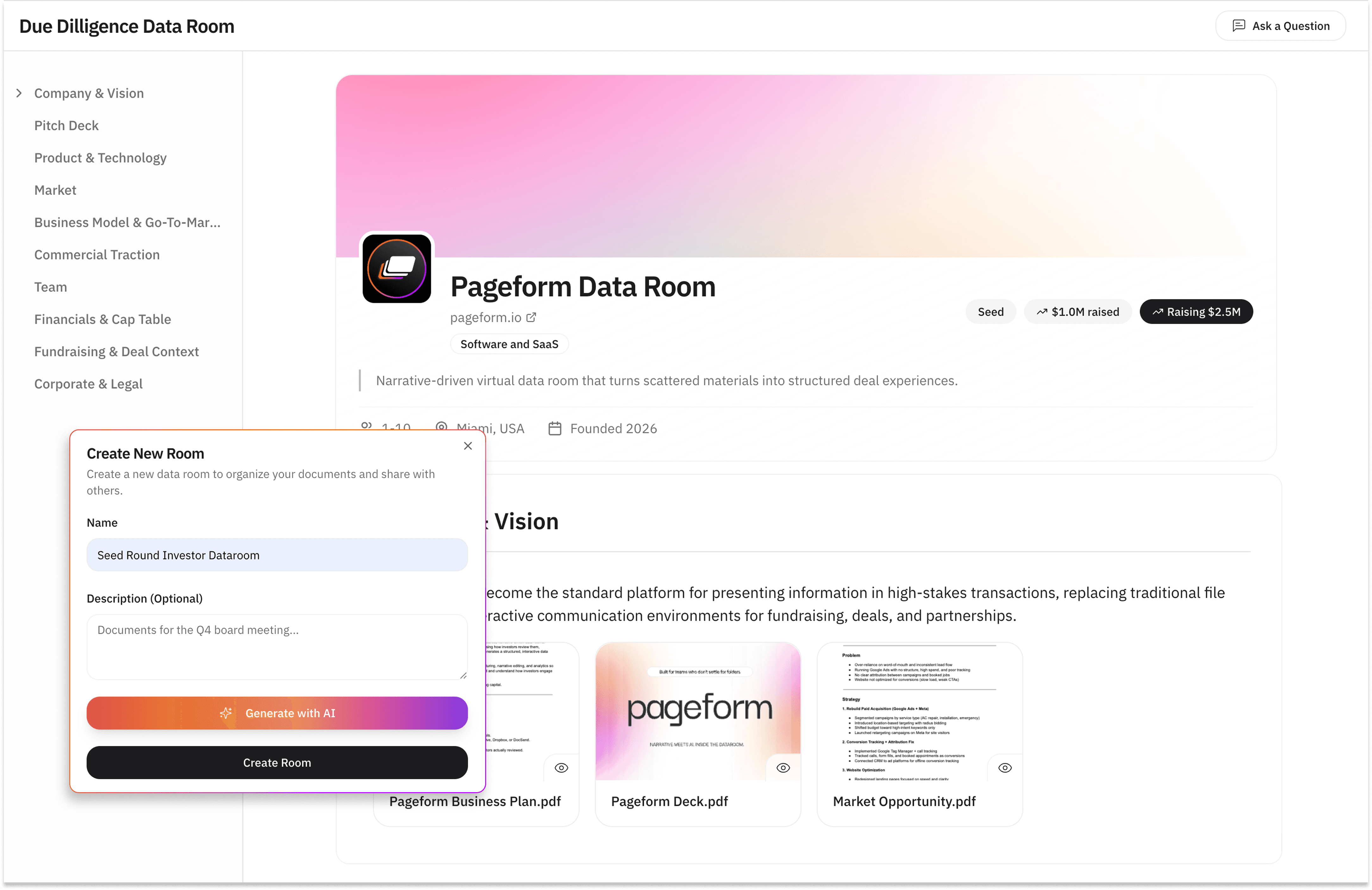
👉 Want to see how Pageform handles private equity due diligence? Book a demo today.