How to Build a Fundraising Data Room in 2026

Artem Axelrod
Co-Founder @ Pageform | AI-native narrative data rooms for fundraising & deals

TL;DR: Your data room should tell your startup's story, not just store files. Start with a narrative structure, organize documents around key investor questions, use analytics to track engagement, and implement proper access controls. Skip generic folders. Pageform lets you build narrative-driven data rooms with personalized links, built-in Q&A, security gating, and engagement tracking. Set up in minutes. Start with a free trial.

I built Pageform after going through the mechanics and struggles of building compelling data rooms as a founder myself. Investors couldn’t find key information, and I kept seeing how messy folders slowed everything down. The problem isn’t just organization. It’s how the story is presented.
Your data room shouldn't just be a collection of folders. It should be the most compelling part of your fundraising process. Here's how to build one that actually works.
Start with your story, not your files
Most founders approach data room creation backwards. They dump all their documents into folders, add some basic labels, and call it done. This is exactly why investors spend 30 seconds skimming your room before moving on.
Instead, start with the story you want to tell. When I tested different data room structures with actual investors, the ones that performed best answered these questions in order:
What problem are you solving and why does it matter?
How big is this opportunity?
Why are you the right team to solve this?
What's your progress and traction?
How will you use the money?
What are the risks and how are you mitigating them?
This narrative structure should drive your entire data room organization. Every document you include should support one of these key points.
Essential documents for your fundraising data room
Here's what actually needs to be in your data room, organized by priority. I'm the founder of a data room platform, so take this with appropriate context, but I've seen what works and what doesn't.
Tier 1: Must-Have Documents
Pitch deck - Your latest investor presentation
Financial model - 3-5 year projections with clear assumptions
Cap table - Current ownership structure
Financial statements - Last 2 years plus current year-to-date
Key metrics dashboard - Your most important KPIs and trends
Product demo - Video walkthrough or live demo link
Team bios - Detailed backgrounds for key team members
Tier 2: Important Supporting Materials
Market research - TAM analysis, competitive landscape
Customer references - Case studies, testimonials, reference contacts
Partnership agreements - Key strategic relationships
Legal structure - Incorporation docs, previous funding rounds
IP documentation - Patents, trademarks, key contracts
Hiring plan - How you'll use the funding to build the team
Tier 3: Due Diligence Materials
These typically come later in the process, but having them ready shows you're organized:
Employment agreements and equity grants
Board meeting minutes and resolutions
Insurance policies
Compliance documentation
Detailed legal and financial records
Structure your data room like a story
The biggest mistake I see founders make is organizing their data room like a file cabinet. Investors don't think in terms of "Legal" and "Financial" folders — they think in terms of questions they need answered.
Here's the structure that works:
1. Executive Summary
Lead with a one-page overview that covers your key metrics, funding ask, and use of funds. Make this scannable. Investors should understand your business in 60 seconds.
2. The Opportunity
Present your pitch deck first, followed by market research and competitive analysis. This section answers "Why should I care about this problem?"
3. The Solution & Traction
Product demos, customer case studies, and key metrics go here. This is where you prove you're solving the problem effectively.
4. The Team
Team bios, organizational chart, and hiring plan. Investors back people, not just ideas.
5. The Business Model
Financial model, unit economics, and revenue projections. Show how you make money and how you'll scale.
6. The Ask
Funding amount, use of funds, and timeline. Be specific about what you need and why.
7. Due Diligence
All the legal and financial documentation they'll need for final diligence.
When I built Pageform's Canvas Builder, this narrative flow was exactly what I had in mind. Instead of forcing investors to hunt through folders, you guide them through your story step by step.
Use Analytics to Improve Your Pitch
Most data rooms are black boxes. You send the link and hope for the best. That’s insane. You wouldn’t run marketing campaigns without analytics, so why run fundraising without data?
Track what investors actually look at:
Which sections get the most time
Where investors drop off
Which documents they download
How long they spend in each section
I built Live Viewer Intelligence into Pageform specifically for this. When I tested it with early customers, founders discovered their financial projections were getting skipped entirely (usually because they were buried too deep) or that investors were spending 80% of their time on customer references (signaling high interest but need for social proof).
Use this data to iterate. If investors aren't engaging with your market research, maybe it's too dense or not compelling enough. If they're spending tons of time on your team section, that might indicate they're worried about execution risk.
Implement Proper Access Controls
Not every investor should see everything immediately. Your data room strategy should match your fundraising process:
Initial Interest Phase
Share your pitch deck, basic financial metrics, and product demo. Keep the detailed financial model and sensitive information gated.
Serious Evaluation Phase
Open up the full financial model, detailed market research, and customer references. You might want NDA protection at this stage.
Due Diligence Phase
Everything becomes available, including legal documents, detailed contracts, and sensitive operational data.
Most generic document sharing tools don't handle this well. They're built for simple file sharing, not complex fundraising processes with different stakeholder needs.
Common data room mistakes to avoid
I've seen founders make these mistakes repeatedly:
Information overload - Including every document you have instead of curating what matters
Outdated information - Sharing old pitch decks or stale financial data
Poor file naming - "Final_deck_v3_REAL_final.pdf" doesn't inspire confidence
No mobile optimization - Investors check data rooms on their phones
Generic presentation - Using the same room structure for every investor type
No follow-up strategy - Building the room and never updating or engaging
Tools and Platforms: What Actually Works
I'm obviously biased here, but let me be honest about the landscape. There are basically three categories of tools:
Generic file sharing (Dropbox, Google Drive): Affordable but not the most user-firendly experience. Fine for internal use, not for fundraising.
Document-focused platforms (DocSend, etc.): Better analytics and access controls, but still fundamentally folder-based and veru expensive. Good for straightforward document sharing.
Narrative-driven platforms (Pageform): Built specifically for fundraising with story-driven UX. Better for complex fundraising processes where you need to guide investor understanding.
The right choice depends on your needs. If you're doing a simple friends-and-family round, DocSend might be fine. If you're doing a formal pre-seed to Series B round with multiple stakeholder types, you need something more sophisticated.
Michael Palank from MaC Venture Capital, $600+ million in assets under management, told us - "This is what every data room should look like" after seeing Pageform. Zach Brodsky from Florida Funders, one of the most active and prominent VC funds in Florida said - "having a consistent, well-structured format like the one Pageform provides is incredibly valuable". If you are fundraising from VCs like these, narrative-driven data room is the way.
Testing and Iteration
Your first data room won't be perfect. Plan to iterate based on investor feedback and engagement data. Ask investors directly: "What information was hard to find?" and "What questions do you still have after reviewing the data room?" Their answers will guide your next version.
I recommend updating your data room monthly during active fundraising. Markets change, your metrics improve, and you learn what resonates with investors.
Build Narrative-Driven Data Rooms with Pageform
Understanding what investors need to see is only half the challenge. The other half is presenting it in a way that builds conviction, not confusion.
With Pageform, founders can:
Structure their data room around a narrative investors actually follow
Guide investors step by step through the story, from problem to ask
Track real-time engagement to know exactly where interest is high and where it drops off
Gate sensitive documents so the right information reaches the right people at the right time
Share personalized links with built-in Q&A, so investors get answers without back-and-forth email chains
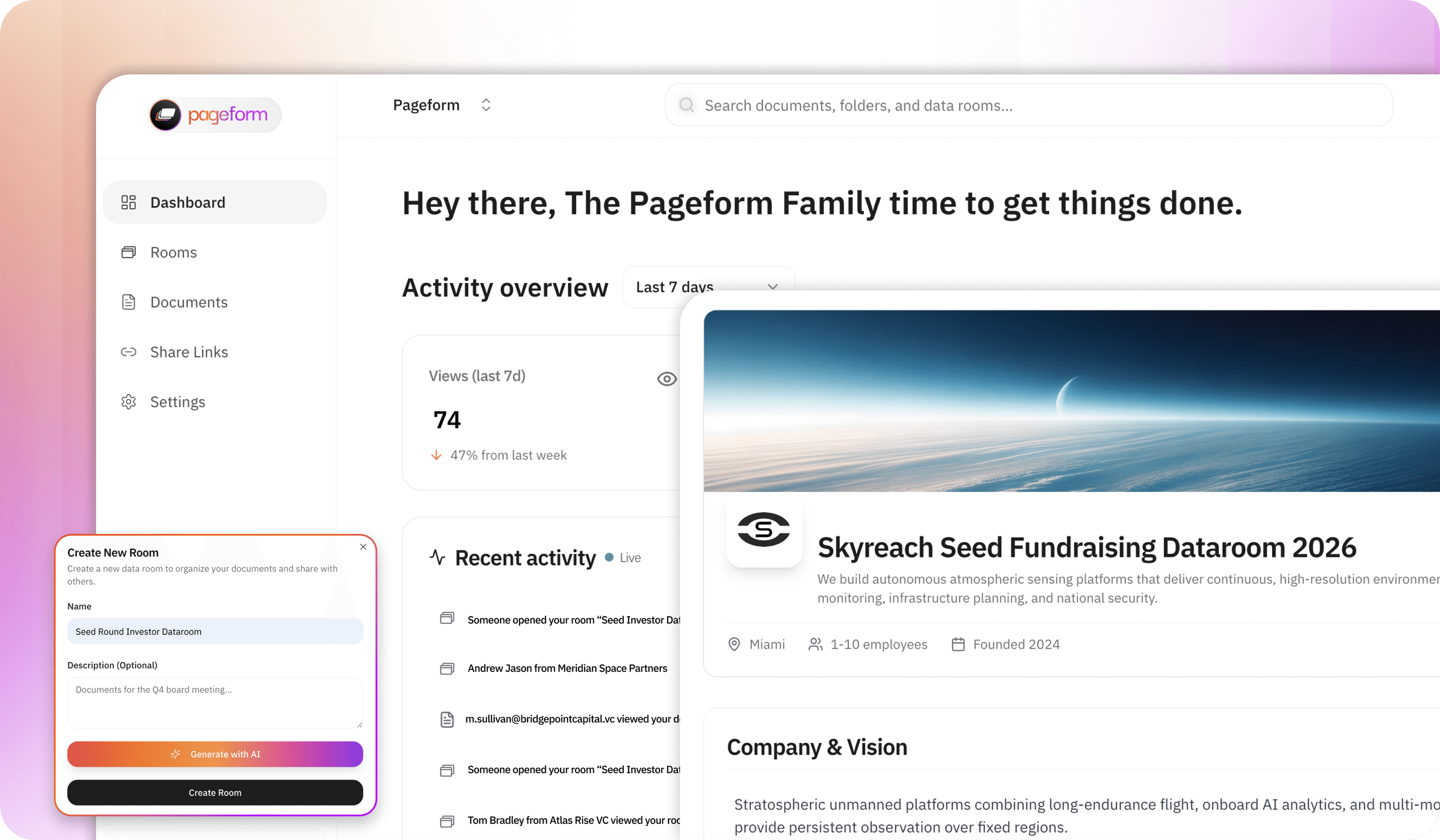
The result: a data room that does not just store your files. It tells your story, surfaces your traction, and makes your startup easier to evaluate and easier to believe in.
When your narrative is tight, your traction is visible, and your room is built for the investor reading it, conviction follows.
👉 Turn your data room into your strongest fundraising asset with Pageform. Start free right now.