How to Prep for Fundraising: A Founder's Guide to 10 Questions Every Investor Will Ask

Artem Axelrod
Co-Founder @ Pageform | AI-native narrative data rooms for fundraising & deals

TL;DR Fundraising prep boils down to answering 10 core questions every investor asks: What problem do you solve? How big is the market? What's your traction? How do you make money? Who's your competition? What's your growth strategy? Who's on your team? How much are you raising? What are your financials? What are the risks? Prepare clear, honest answers backed by data, organize everything in a narrative-driven data room, and practice your pitch until it's conversational.

I built Pageform because I watched too many founders fumble through fundraising with scattered documents and no narrative structure. As someone who's been through the fundraising journey myself, I know the prep work can make or break your round.
Here's the thing: every investor conversation follows predictable patterns. They'll ask roughly the same 10 questions, just phrased differently. If you can nail the prep for these questions, you'll walk into every pitch meeting confident instead of scrambling.
The 10 Questions Every Investor Will Ask (And How to Prep for Each)
I've sat through hundreds of investor conversations, both as a founder and watching other founders pitch. The questions are remarkably consistent. Here's how to prep for each one.
1. What Problem Are You Solving?
This seems obvious, but I've watched founders stumble here more than anywhere else. You need to articulate the problem in a way that makes investors feel the pain.
How to prep:
Write a one-sentence problem statement
Collect 3-5 customer quotes that illustrate the pain point
Quantify the problem with data (time lost, money wasted, etc.)
Practice explaining it to someone who knows nothing about your industry
When I tested early versions of Pageform, I had founders tell me "our data room is just a Google Drive folder with 47 files." That's the kind of specific, relatable problem statement that works.
2. How Big Is the Market?
Skip the "$2 trillion market" nonsense. Investors want to understand your addressable market, not the entire global economy.
How to prep:
Calculate your TAM (Total Addressable Market) with bottom-up math
Define your SAM (Serviceable Addressable Market) realistically
Show market growth trends with credible sources
Include 2-3 market sizing methodologies to cross-check your numbers
For Pageform, I don't say "the document management market is $6 billion." I say "there are roughly 150,000 startups fundraising annually in the US, and 60% use dedicated data room software." Much more believable.
3. What's Your Traction?
This is where you prove people actually want what you're building. Traction isn't just revenue, it's any evidence of product-market fit.
How to prep:
Create a traction slide with 4-6 key metrics
Show month-over-month growth rates
Include leading indicators, not just lagging ones
Prepare the story behind any dips or plateaus
Early-stage? Focus on engagement, retention, or real usage signals. I’m the founder, so take this with context, but before Pageform had any meaningful user base, I focused on how people were actually using it and the feedback they shared. That’s more compelling than forcing weak revenue metrics.
4. How Do You Make Money?
Investors want to understand your business model and path to profitability. Be crystal clear about how money flows through your business.
How to prep:
Create a simple revenue model diagram
Calculate unit economics (CAC, LTV, gross margins)
Show pricing strategy and rationale
Include 3-year revenue projections with assumptions
For SaaS businesses like Pageform, this is straightforward: monthly subscriptions with clear pricing tiers. But I also explain why we chose freemium (product-led growth) versus sales-led approaches.
5. Who's Your Competition?
Never say "we have no competition." Everyone has competition, even if it's Excel spreadsheets or manual processes.
How to prep:
Map direct and indirect competitors
Create a competitive matrix with key features
Be honest about competitors' strengths
Clearly articulate your differentiation
DocSend has broader feature coverage and stronger brand recognition. But is also very expensive. Pageform is built specifically for fundraising narratives, not generic document sharing and adopts founder-first affordable pricing. That focus is the differentiation.
6. What's Your Growth Strategy?
Investors want to see you can scale beyond your current traction. This isn't about hockey stick projections, it's about realistic growth channels.
How to prep:
Identify your top 3 growth channels
Show early experiments and results
Calculate potential scale for each channel
Include go-to-market timeline and milestones
For Pageform, I focus on content marketing (like this post), founder community engagement, and product-led growth. I show early metrics from each channel and realistic projections.
7. Who's on Your Team?
Investors back teams, not just ideas. They want to understand why you're the right people to solve this problem.
How to prep:
Create one-slide team bios focusing on relevant experience
Highlight domain expertise and complementary skills
Address any obvious gaps and hiring plans
Include advisors and key supporters
A small or part-time team isn’t ideal for most investors, so be upfront about it. Then focus on how the team is structured, why it works for your current stage, and what key hires you plan to make next.
8. How Much Are You Raising?
This seems simple, but investors want to understand your raise size, timeline, and use of funds.
How to prep:
Create a detailed use-of-funds breakdown
Show 18-24 month runway calculations
Include key milestones you'll hit with this funding
Prepare for "what if you only raise X?" scenarios
Be specific: "We're raising $500K to hire two engineers and a marketing person, giving us 20 months of runway to reach $50K MRR." Much better than "we're raising $500K to grow the business."
9. What Are Your Financials?
Even early-stage founders need basic financial projections and unit economics. Investors want to see you understand the numbers.
How to prep:
Create 3-year P&L projections
Calculate key SaaS metrics (if applicable)
Show cash flow projections
Include scenario planning (conservative, base, optimistic)
Your projections will be wrong. That's fine. Investors want to see your thinking process and assumptions, not perfect predictions.
10. What Are the Risks?
This is where many founders freeze up. Don't pretend risks don't exist. Address them head-on with mitigation strategies.
How to prep:
Identify 4-5 key risks to your business
Explain likelihood and potential impact
Show mitigation strategies for each
Include market, execution, and competitive risks
For Pageform, key risks include market size (maybe fewer startups need dedicated fundraising tools than I think) and competitive pressure from established players. I address both with data and differentiation strategies.
Organizing Everything: Beyond the Pitch Deck
Here's where most founders mess up: they nail the pitch but fumble the follow-up. Investors will ask for supporting materials, and how you present them matters.
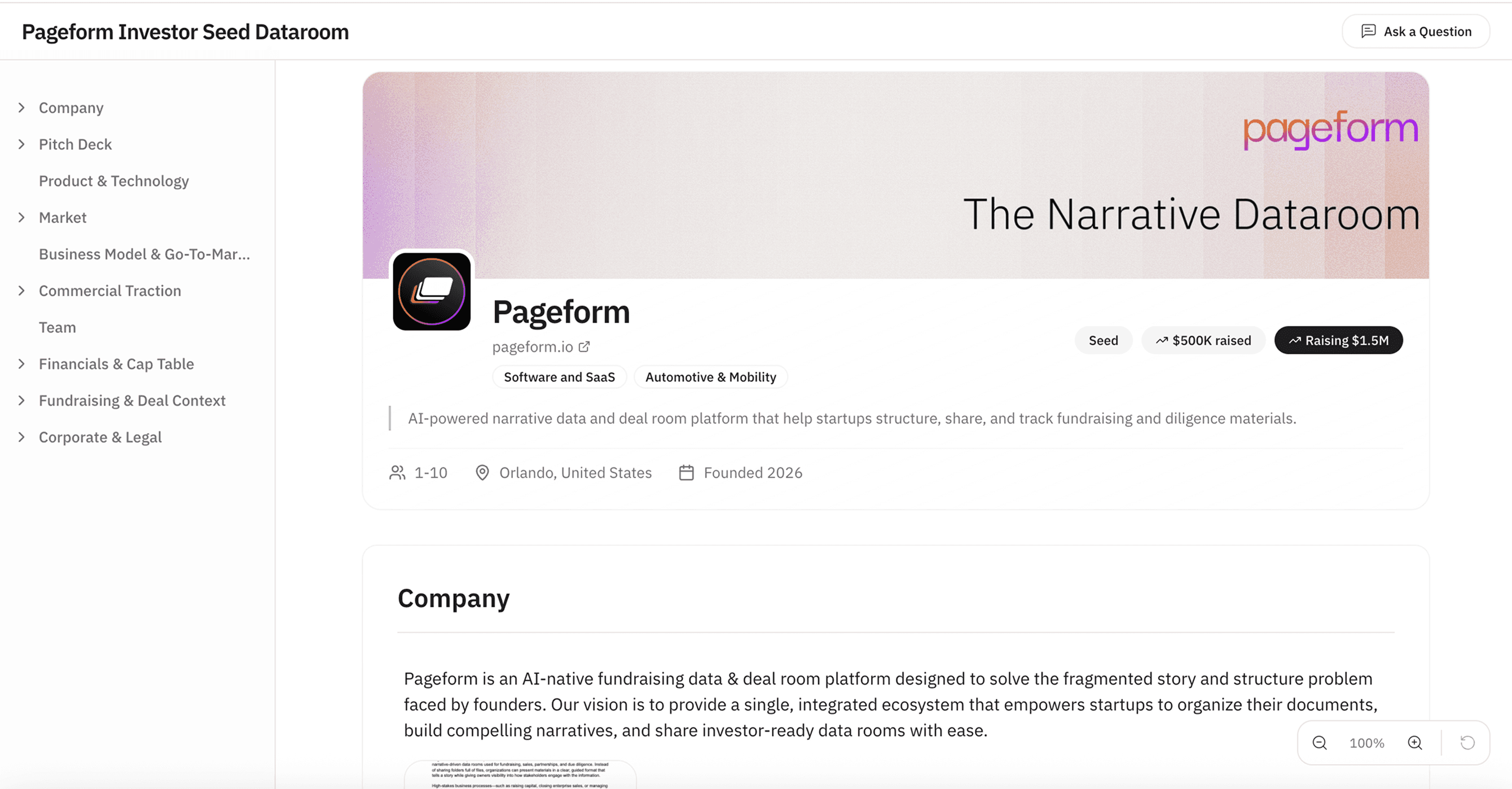
Your data room is your second impression. It should tell a coherent story, not dump files in random folders. When I built Pageform's Canvas Builder, I designed it to turn scattered documents into a guided narrative because that's what investors actually want to see.
Essential data room sections:
Company overview and pitch deck
Financial projections and historical data
Legal documents (cap table, incorporation docs)
Product demos and roadmap
Market research and competitive analysis
Team information and key hire plans
The Live Viewer Intelligence feature in Pageform shows me which sections investors spend time on. Spoiler alert: they skip around a lot and rarely read everything linearly. Design for that behavior.
Testing Your Prep
All this prep is worthless if you don't test it. Here's how I recommend pressure-testing everything:
Practice Conversations
Find 3-5 people to run through your pitch and Q&A. Include someone who knows your industry and someone who doesn't. Their questions will reveal gaps in your preparation.
Time Your Responses
Investor meetings are time-constrained. Practice answering each of the 10 questions in 2-3 minutes max. You can always go deeper if they're interested.
Stress Test Your Numbers
Double-check every number in your presentation. Investors will spot inconsistencies between your pitch deck and financial models. Trust me on this one.
The Honest Truth About Fundraising Prep
Here's what I wish someone had told me: perfect preparation doesn't guarantee funding, but poor preparation guarantees rejection.
Most founders spend 80% of their time on the pitch deck and 20% on everything else. Flip that ratio. Your pitch gets you in the room, but your answers to these 10 questions get you term sheets.
Also, fundraising is a numbers game. Even with perfect prep, most pitches result in "no." That's normal. What matters is giving yourself the best possible shot with each conversation.
Ready to Move Beyond Folders?
If you want to create a narrative-driven fundraising experience that engages investors instead of just sharing files, try Pageform free. No credit card required, and you can have a professional data room running in minutes.
👉 Turn your data room into your strongest fundraising asset with Pageform. Start free right now.