What Should a Pre-seed Data Room Include?


Artem Axelrod
Co-Founder @ Pageform | AI-native narrative data rooms for fundraising & deals

TL;DR: A pre-seed data room doesn't need to be perfect, it needs to be clear. At minimum: pitch deck, financial model, cap table, incorporation docs, product screenshots or demo, market thesis, and team bios. Skip the audited financials and extensive legal docs — no one expects that yet. What investors do expect is a room that's easy to navigate and tells a coherent story. The platform matters less than the structure.

I'm Artem, founder of Pageform, and I've been thinking about data rooms for pre-seed companies a lot lately. When I built Pageform, I was specifically focused on the fundraising journey, but I've learned that pre-seed has some unique challenges that most data room platforms don't address well.
Here's the thing: if you're raising pre-seed, you probably don't have the same document library as a Series A company. You might not even have audited financials yet. But you still need to tell a compelling story and organize what you do have in a way that builds investor confidence.
Before diving into platforms, let's talk about what actually belongs in a pre-seed data room. I've seen too many founders either over-engineer this or leave out critical pieces.
The Essential Documents
Your pre-seed data room should include:
Pitch deck (obviously, but make sure it's the same version you presented)
Financial model and any historical financials you have
Cap table and current ownership structure
Legal docs: incorporation papers, any existing investor agreements
Product demo or screenshots if you have something built
Market research that supports your thesis
Team bios and relevant background info
What You Probably Don't Need Yet
Don't stress about having audited financials, detailed IP portfolios, or extensive legal documentation. Most pre-seed investors expect you're still figuring some of this out. Focus on what demonstrates traction, market opportunity, and team capability.
Top Data Room Platforms for Pre-seed in 2026
I've tested most of these platforms (occupational hazard of building in this space), and here's my honest take on each:
1. Pageform
I'm the founder, so take this with appropriate context, but I built Pageform specifically for fundraising scenarios like pre-seed.
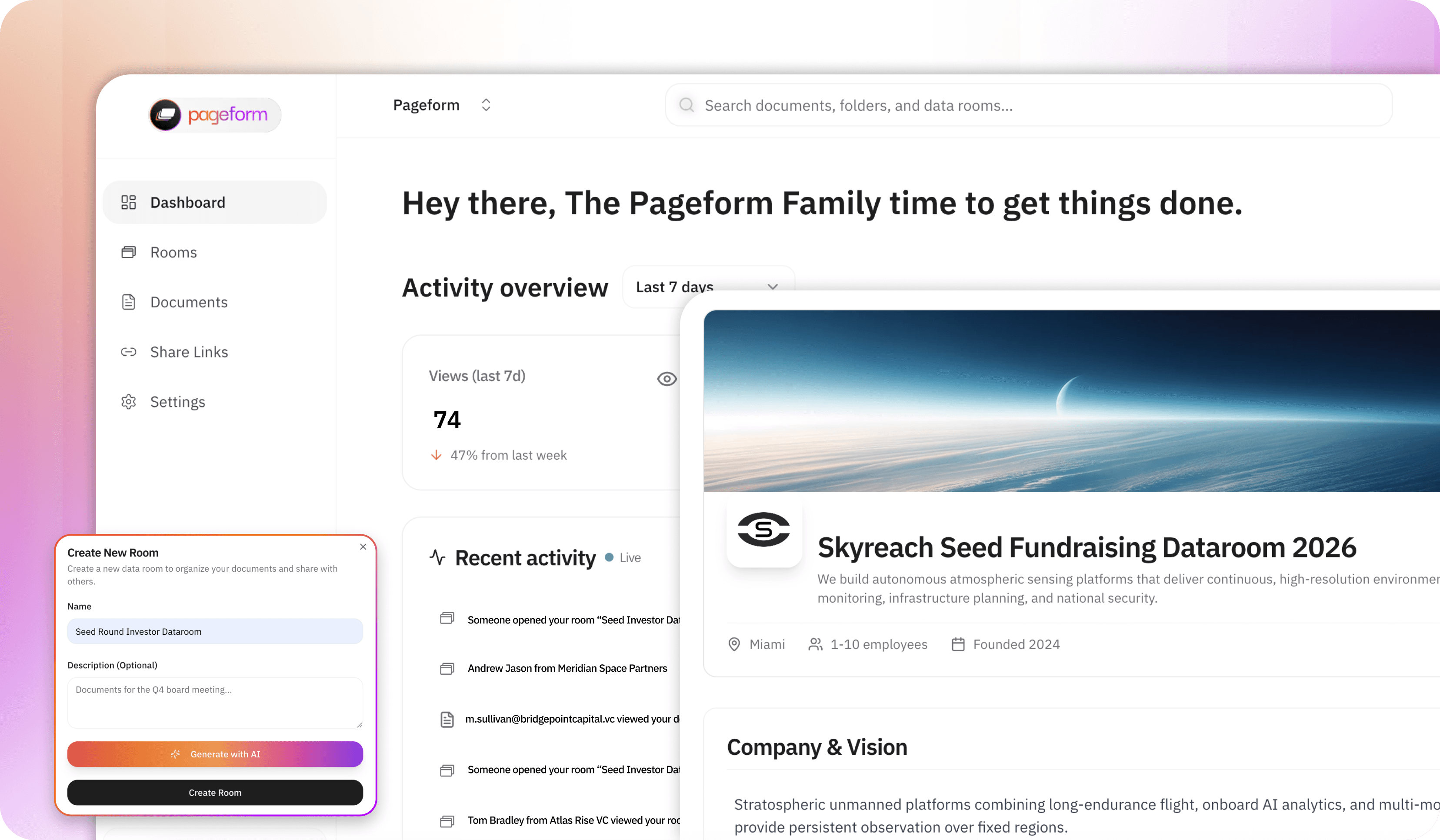
What makes it different: Instead of just uploading files, you create a narrative experience. The Custom Canvas Builder lets you guide investors through your story in a logical flow, rather than making them dig through folders.
Best for: Founders who want to control the investor experience and tell a cohesive story. The AI-generated structure feature is particularly helpful if you're not sure how to organize everything.
Limitations: We're newer than DocSend, so we don't have the same brand recognition. Some investors might be unfamiliar with the format, though the feedback I get is usually "this is what every data room should look like" (shoutout to Michael Palank at MaC VC for that quote).
Pricing: Free plan gets you started with creating 1 room. Update it to Core Plan at $55/mo to share that data room, share unlimited documents and have detailed page analytics, which is sufficient for most pre-seed raises.
2. DocSend
The incumbent. DocSend has been around forever and most investors know how to use it.
What works: Robust analytics, professional appearance, reliable platform. The section-level tracking helps you understand what investors are actually reading.
What doesn't: It's essentially a fancy file folder. You upload documents and hope investors can piece together your story. The user experience feels dated compared to newer platforms.
Best for: Founders who want the "safe" choice that every investor recognizes and have $300/mo to spare.
Pricing: Starts around $250/mo for their first data room plan.
3. Notion
Hear me out on this one. I've seen some clever pre-seed founders use Notion as a data room, and it can actually work well.
What works: You probably already use Notion. You can create structure, embed documents, and establish controls. It's familiar and flexible.
What doesn't: No investor-specific analytics, limited access controls, doesn't look as professional as purpose-built solutions.
Best for: Super early-stage founders who are bootstrapping everything and already have their information organized in Notion.
Pricing: You're probably already paying for it, so effectively free.
4. Google Drive
The budget option that works - Google Drive.
What works: Everyone knows how to use it. You can organize folders logically, control sharing permissions, and it's free.
What doesn't: Zero analytics about investor engagement. Looks unprofessional. No way to control the experience or tell a story.
Best for: Very early pre-seed where you're testing investor interest and don't want to invest in tools yet.
Pricing: Free (with storage limits).
5. Foundersuite
A fundraising-focused Foundersuite platform that includes data room functionality.
What works: Built for fundraising, includes investor CRM features.
What doesn't: The data room feels secondary to the CRM. Limited structure and less polished compared to dedicated solutions.
Best for: Founders prioritizing investor CRM and outreach, who don’t need a structured or narrative-driven data room.
My Recommendations by Use Case
When I talk to pre-seed founders, their needs usually fall into one of these categories:
If You Want to Tell a Story
Use Pageform or build something custom in Notion. Traditional data rooms make investors piece together your narrative from scattered documents. That's backwards.
When I tested traditional folder-based approaches versus narrative structures, investors consistently said the story-driven format helped them understand the opportunity faster.
If You Want the "Safe" Choice
Go with DocSend. Every investor has used it, it works reliably, and you won't get any weird looks. It's not innovative, but it gets the job done in $300/month, $3,600+ per year.
If Budget is Tight
Start with Google Drive or Notion, but plan to upgrade once you're getting serious investor interest. The lack of analytics will hurt you in later conversations when investors ask follow-up questions and you have no idea what they actually looked at.
If You're Technical and Want Data
DocSend or Pageform both offer solid analytics. DocSend gives you more traditional metrics, while Pageform shows you the narrative journey investors took through your materials.
What Most Pre-seed Founders Get Wrong
The biggest mistake I see is treating the data room like a document dump. Investors don't want to hunt through folders to understand your business.
Think about it like this: your pitch deck tells a story in 15 slides. Your data room should tell the same story with supporting evidence. If an investor can't figure out your key points within the first few minutes of browsing your data room, you've lost them.
The second mistake is over-engineering it. You don't need enterprise-grade security for a pre-seed raise. You need clarity, professionalism, and the ability to understand investor engagement.
Final Thoughts
I built Pageform because I was frustrated with the folder-based approach to data rooms, but I'm honest about the fact that different founders have different needs. The most important thing is matching your choice to your specific situation.
If you're raising pre-seed, you're at the beginning of a long journey. Pick something that serves your immediate needs but can scale as you grow. And remember, the platform matters less than the story you're telling and the evidence you're providing.
Ready to Build Your Narrative-Driven Data Room?
If you want to try the story-first approach, sign up for Pageform for free and see how narrative-driven data rooms can change your investor conversations. The free plan gives you everything you need to get started.
👉 Turn your data room into your strongest fundraising asset with Pageform. Start free right now.