Narrative Data Room: Definition, Structure, and When to Use One

Ksenia Moskalenko
Co-Founder @ Pageform | AI-native narrative data rooms for fundraising & deals

TL;DR: A narrative data room is a virtual data room structured around the investor's decision-making journey, not around your file cabinet. Instead of organizing documents into generic folders like "Legal" and "Financials," a narrative data room guides investors through a logical story: the problem, the opportunity, the team, the traction, and the ask. Done well, it also functions as a deal memo investors can reference and share internally. Here's what it means, how it works, and why the format matters for your raise.

At Pageform, we've been obsessing over data rooms since going through the fundraising process ourselves as founders. Working with and watching how investors actually work through a room, what they open, what they skip, where they get stuck, shaped everything about how we built the product. A narrative data room isn't just a feature we offer. It's the philosophy behind why Pageform exists.
The standard data room is a file dump
Most founders set up their data room the same way they organize their desktop. Folders. Subfolders. Files named "Deck_Final_v3_ACTUALLY_FINAL.pdf."
It's organized for the person who built it, not the person reading it.
An investor who opens a traditional data room has to do a lot of work: figure out what order to read things, hunt for the specific documents that answer their questions, and mentally reconstruct your company's story from a pile of unconnected files. Most won't. They'll skim the business plan, glance at the financial model, and move on.
The format of your data room isn't neutral. It actively shapes how an investor understands your company and whether they can make a case for you internally.
What is a narrative data room?
A narrative data room is a virtual data room organized around the questions investors are actually asking, in the order they naturally ask them.
Instead of folders, you have a guided sequence. Instead of a file cabinet, you have a story with evidence attached.
The term describes a specific approach to deal room design: one where the structure of how documents are presented is treated as part of the pitch and wrapped around your materials.
A narrative data room typically answers six questions in order:
What problem are you solving, and why does it matter?
How large is the opportunity?
Why is this team the right one to capture it?
What traction proves you're on the right path?
How will you use this capital?
What are the risks, and how are you managing them?
Every document in the room supports one of those questions. Nothing lives in a generic folder. Nothing is buried.
Narrative data rooms also function as deal memos
This is something founders don't often think about but investors appreciate immediately.
When an investor wants to bring a deal to their partners or share it with a co-investor, they need to tell the story themselves. If your data room is a folder dump, they have to reconstruct that story from scratch. Many won't bother. They'll either pass or send a vague summary that undersells you.
A well-structured narrative data room does that work for them. The sequence of sections, the context between documents, the executive summary up front — it reads like a memo. Investors can share the room link with a partner and that partner gets the full picture without a separate briefing. The story travels with the documents.
This is one of the most underrated functions of a narrative data room. It doesn't just help you present to investors. It helps investors present you to each other.
How narrative data rooms differ from traditional data rooms
Traditional Data Room | Narrative Data Room | |
|---|---|---|
Structure | Organized by document type (Legal, Financial) | Organized by investor question |
Investor experience | Self-directed; investor hunts for context | Guided; investor follows a logical sequence |
Storytelling | Absent or left to the pitch deck alone | Embedded throughout |
Internal sharing | Raw folder link; no context travels with it | Functions as a memo; story travels with the room |
Analytics | Basic (document opens, downloads) | Section-level engagement, drop-off points |
Examples | Dropbox, Google Drive, basic DocSend rooms | Pageform |
Why the format affects investor engagement
When an investor has to work hard to understand your company, friction builds. Every unanswered question becomes a reason to schedule another call, wait on a follow-up email, or deprioritize the deal in favor of one that's easier to evaluate.
When an investor moves through a well-structured room and each section answers the question they were just forming, understanding builds sequentially. They arrive at your ask with context already in place.
Three things tend to happen differently in a narrative data room:
1. Investors spend more time on high-signal sections. Engagement data from Pageform rooms shows founders who use a narrative structure consistently see more time on traction and team sections. In folder-based rooms, investors often never reach those sections because they get stuck or lose interest navigating disorganized files first.
2. Fewer follow-up questions. The most common investor follow-ups — "can you send me your cap table," "where's the market sizing," "do you have customer references" — are usually symptoms of a data room that didn't surface the right information at the right moment. A narrative room anticipates those questions and answers them in sequence.
3. Faster close of fundraise. When investors have fewer questions, less to chase down, and an easier time advocating internally, the overall process compresses. Not because you rushed anything, but because you removed the friction that slows most raises down. The back-and-forth shrinks. Decisions come sooner.
What goes into a narrative data room
The document list isn't radically different from a traditional data room. What changes is the grouping, the sequence, and how each section is framed.
Here's how a real Pageform data room is structured, using our sample Navo startup data room as an example.
1. Company and vision The room opens with a one-paragraph company overview that tells investors what the company does, the problem it solves, and why it exists -- in plain language, before they've opened a single document. This is the executive summary layer that sets the frame for everything that follows.
2. Pitch deck The deck comes second, not first. The company overview earns the right for the deck to land properly. Investors read it with context already in place.
3. Product and technology Demo video, architecture overview, platform walkthrough. This section shows rather than tells. Investors who are intrigued by the deck want to see the product immediately -- so it's here, before market or financials.
4. Market TAM, SAM, SOM with a brief narrative explaining the target segment and why now. Comes after product because investors need to believe the product works before they care about market size.
5. Business model and go-to-market Pricing tiers, GTM strategy, and supporting documents. Answers: how does this make money and how will it grow? This section answers: "How does this make money?"
And the rest you will see inside Pageform data room interface.
When should you use a narrative data room?
Narrative data rooms are particularly valuable when:
You're raising a formal pre-seed, seed, or Series A round
You're pitching to institutional investors or funds, not just angels
You have multiple investor types accessing the room at different stages
Your company story is nuanced and needs context to land properly
You want engagement data to inform follow-up timing and messaging
They're less critical for simple friends-and-family rounds where relationships carry the weight. For everything else, the format is a competitive advantage.
How to build one
If you use Pageform, the Canvas Builder is built around this structure. You set up sections that correspond to investor questions, attach documents, add context and commentary between them, and the room guides investors through your story step by step. You can gate sections by stage, track engagement at the section level, and share personalized links with built-in Q&A interface.
You can have one live in under 10 minutes. Start free here.
The bottom line
The way you organize your data room is a signal. A disorganized room signals a disorganized team. A folder-based room signals you're thinking about your company from the inside, not from the investor's seat.
A narrative data room signals that you understand how investors think, you've done the work to guide them, and your story holds up under scrutiny.
That perception difference matters in a process where investors are evaluating dozens of companies at once and the ones that are easiest to understand and advocate for internally get the most attention.
The best pitch deck in the world won't close a round if the data room behind it makes investors feel like they're digging through a filing cabinet.
Frequently Asked Questions
What is a narrative data room? A narrative data room is a virtual data room organized around the questions investors ask during due diligence, in the logical order they ask them. Rather than grouping documents by type (legal, financial, team), a narrative data room guides investors through a structured story from problem to ask, with documents attached as evidence at each stage.
How is a narrative data room different from a regular data room? A traditional data room is organized like a file system: folders by document category, no inherent sequence, no investor guidance. A narrative data room is organized like a story: each section answers a specific investor question, documents support that answer, and the investor moves through a logical flow that builds understanding incrementally.
Can a narrative data room function as a deal memo? Yes, and this is one of its most practical advantages. When the room is structured around a clear story with an executive summary up front, it reads like a memo. Investors who want to share the deal internally can send the room link and the story travels with it, rather than having to write a separate briefing from scratch.
Does the format of a data room actually affect fundraising outcomes? Format determines how much time investors spend on key sections and how many follow-up questions they need answered separately. Founders using narrative-structured rooms report fewer clarification requests and an easier time getting investors to share deals internally. Neither outcome is guaranteed, but a clear structure reduces friction at every step.
What tools let you build a narrative data room? Pageform is built specifically for narrative data rooms, with a Canvas Builder that structures rooms around investor questions, section-level analytics, stage-based access control, and personalized sharing links. Legacy platforms like DocSend and generic file sharing tools like Google Drive or Dropbox don't support narrative structure natively.
How long does it take to set up a narrative data room? With Pageform, you can have a narrative data room live in under 10 minutes. The Canvas Builder walks you through the standard structure and you attach your existing documents to each section.
Build Narrative-Driven Data Rooms with Pageform
Understanding what investors need to see is only half the challenge. The other half is presenting it in a way that builds conviction, not confusion.
With Pageform, founders can:
Structure their data room around a narrative investors actually follow
Guide investors step by step through the story, from problem to ask
Track real-time engagement to know exactly where interest is high and where it drops off
Gate sensitive documents so the right information reaches the right people at the right time
Share personalized links with built-in Q&A, so investors get answers without back-and-forth email chains
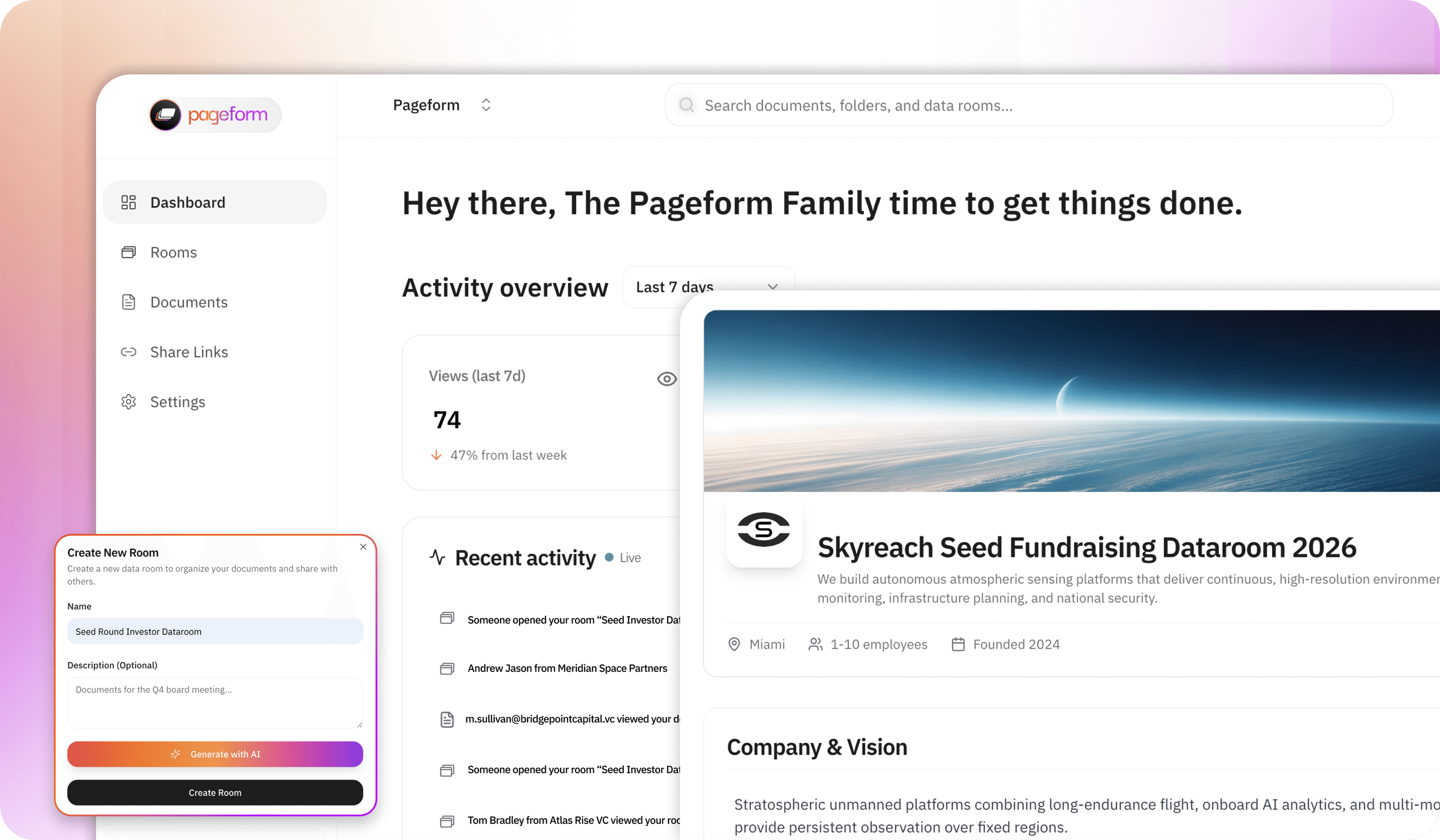
The result: a data room that does not just store your files. It tells your story, surfaces your traction, and makes your startup easier to evaluate and easier to believe in.
When your narrative is tight, your traction is visible, and your room is built for the investor reading it, conviction follows.
👉 Turn your data room into your strongest fundraising asset with Pageform. Start free right now.