Raising Capital in Florida: Record Rounds and New Programs for Founders


Ksenia Moskalenko
Co-Founder @ Pageform | AI-native narrative data rooms for fundraising & deals

Raising capital in Florida: Record Rounds and New Programs for Founders
Last updated: August 6, 2026
Raising capital in Florida looks different in 2026 than it did even a year ago. Over the past few weeks, more than $450 million dollars in mega rounds closed across Orlando, Lake Mary, and Miami, proof that the state now produces category leaders that national investors chase. At the same time, two new programs are targeting the opposite end of the founder journey. Florida Funders and the Institute for Commercialization of Florida Technology unveiled Florida First Check, an evergreen pre-seed strategy built to be the earliest institutional check in the state. And the Florida High Tech Corridor is launching Capital Pathways with the Truist Foundation to get founders capital and support sooner. The record rounds prove the top of the funnel works. The new programs are bets on the bottom of it, so the next generation of founders can raise without leaving.
The mega rounds: Florida is closing category leaders
Late-stage capital does not usually flow to companies that have to explain where they are based. Four recent Florida rounds show that stopped being a problem here.
In Orlando, ThreatLocker closed a $190 million dollar Series F led by Elephant, with support from D. E. Shaw Ventures, Arthur Ventures, and a new investment from Koch Disruptive Technologies. The zero trust cybersecurity company is now valued at roughly 1.8 billion dollars and has raised close to half a billion in total. The new capital funds work on AI-related security risks and international expansion, starting with a U.K. office.
In Lake Mary, Spur Intelligence secured a 200 million dollar investment from Insight Partners, announced on July 28. Spur was founded in 2017 by Riley Kilmer and Ethan Smith, two former U.S. Defense Department engineers. Its IP intelligence platform identifies traffic routed through VPNs, residential proxies, and bot networks, a problem that has grown sharply as AI makes fraud harder to trace.
In Miami, Maximum emerged from stealth on August 3 with a 30 million dollar seed led by CRV, joined by Pear VC, Restive, Plug and Play Ventures, and Anthemis. Founder Randy Fernando is building an AI-native operating system for banks. The thesis is blunt: legacy cores that run more than 70 percent of U.S. banks were built to record data overnight, not to power real-time AI agents. Banks need new core infrastructure, not another add-on.
Also in Miami, RapidPulse closed an oversubscribed 48 million dollar Series B on July 16, co-led by Medtronic, TechWald Next, and S3 Ventures, with the Florida Opportunity Fund among the investors. The company's cyclic aspiration technology improves clot removal during stroke procedures. The round funds its TURBO clinical study and its path toward FDA approval.
Four rounds, four different sectors: cybersecurity, fraud infrastructure, core banking, and medtech. That spread matters. It means Florida is not a one-industry story. It is producing companies that national and strategic investors will travel for. For a sense of who backs companies earlier in that journey, our roundup of early-stage VC funds in Florida maps the local players who often write the checks that come before a mega round.
Florida First Check: filling the earliest gap
Mega rounds are the visible end of a funding chain. The invisible end is the first check, the one that turns an idea and a founder into a company with a bank account and a runway. That check has long been the weakest link in Florida. Founders with promising pre-seed startups often had to fly to the coasts to find institutional money willing to go first. Many of them moved for good.
Florida First Check is a direct answer to that problem. Florida Funders and the Institute for Commercialization of Florida Technology built it as an evergreen pre-seed strategy, with Florida Funders serving as investment manager. The plan is to deploy first checks of $75,000 to $100,000 into pre-seed companies across the state.
Two design choices make it more than a small fund. First, it is positioned deliberately in the chain. First Check sits ahead of seed investors like DeepWork Capital and the Florida Opportunity Fund, which in turn sit ahead of the Florida Growth Fund at Series A and B. That means a Florida founder can, in theory, move from first check to growth capital without ever leaving the state's institutional network.
Second, the structure is self-sustaining. Proceeds from early investments recycle back into future startups. This is not a one-time pool that runs dry after a good year. It is designed as a durable pipeline, which is the harder and more valuable thing to build. A recurring source of first money changes the calculus for a founder deciding whether to stay or relocate.

Florida Capital Pathways: the same gap, a different angle
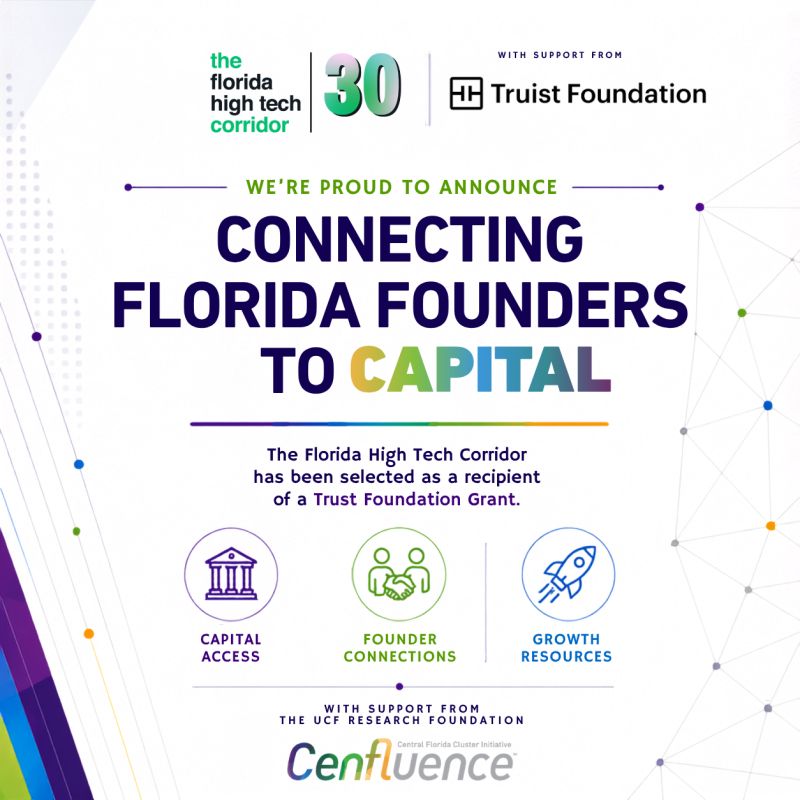
The Florida High Tech Corridor is going after the same problem from a different direction. Its new Capital Pathways program, run with the Truist Foundation, aims to give founders access to capital, technical assistance, and ecosystem support earlier in their journey. Where First Check is an investment vehicle, Capital Pathways is closer to a readiness and connection layer, the work that helps a founder become fundable in the first place.
Both programs point at the same conviction. Florida can produce billion-dollar outcomes, as ThreatLocker and the others show, but only if the earliest founders can find capital and guidance without booking a one-way flight. The mega rounds prove the ceiling. First Check and Capital Pathways are bets on the floor.
Note: at the time of writing, details on Capital Pathways are drawn from the program's own description as it launches. Founders should confirm current specifics with the Florida High Tech Corridor directly.
Ambition Accelerated: a statewide platform to scale
The third program works further along the journey, once a founder has a company worth scaling. Ambition Accelerated, powered by the Florida Council of 100 and its Foundation, grew out of the 2025 Gold Coast Tech Accelerator into a statewide platform. Its aim is to organize Florida's regions and industries into one coordinated system so high-growth companies build and scale in the state rather than leave it.
For 2026 the platform is running four hybrid, industry-focused accelerators, each anchored in a region with a distinct strength: fintech in West Palm Beach, dual-use and defense tech in Miami, health tech in Tampa, and resilience at Babcock Ranch. Applications are open through August 21, 2026, with the program running from October into early December. Selected founders get access to mentorship from senior operators, corporate pilot partnerships, and Florida's investor network. One founder and co-founder from each company also receive a one-year Embarc Collective membership scholarship for 2027, and Embarc Collective has joined as a statewide platform partner providing coaching across all four accelerators.
Where First Check and Capital Pathways address the first dollars and the readiness to raise them, Ambition Accelerated addresses the next step, turning a fundable company into one with real customers and enterprise traction. Together the three cover a wider stretch of the founder journey than any single program could. Florida can produce billion-dollar outcomes, as ThreatLocker and the others show, but only if founders can find capital, guidance, and customers without booking a one-way flight.
What this means for Florida founders
Put the three developments together and a pattern appears. The state is filling in its funding chain from both ends at once. Late-stage investors are validating Florida-built companies. New pre-seed capital and support are arriving to seed the next batch. For a founder, that changes what is possible without leaving.
It also raises the bar on preparation. When more institutional capital operates in-state, more founders will be in real diligence with real investors sooner. First checks still come with expectations. A first-check investor writing 75,000 to 100,000 dollars wants to see a clear story, honest numbers, and a founder who can move fast when a term sheet appears. That is a readiness problem as much as a capital problem, and it is worth solving before you start pitching, not during. Our guide on how to prep for fundraising walks through the questions early investors ask first.
Part of being ready is how you present the company when an investor leans in. A founder who can share a clean, organized set of materials the moment interest turns serious keeps momentum on their side. A founder scrambling to assemble documents loses it. If you are getting your materials in order for a Florida raise, our startup fundraising data room checklist is a practical place to start.
The larger takeaway is simple. Florida spent years being described as an emerging ecosystem. The past few weeks read less like emergence and more like maturity. Category leaders are closing large rounds here. Institutions are building durable pipelines to fund the next wave here. The job now is to make sure founders know these paths exist, and to help the next generation stay and build.
If you know a Florida pre-seed founder who should hear about Florida First Check or Capital Pathways, tell them. The whole point of these programs is that the first check should not require a plane ticket.
FAQ
How much capital closed in Florida mega rounds recently?
More than $450 million dollars across four companies: ThreatLocker in Orlando with 190 million, Spur Intelligence in Lake Mary with 200 million, RapidPulse in Miami with 48 million, and Maximum in Miami with 30 million. The rounds span cybersecurity, fraud infrastructure, medtech, and core banking.
What is Florida First Check?
Florida First Check is an evergreen pre-seed investment strategy from Florida Funders and the Institute for Commercialization of Florida Technology. Florida Funders acts as investment manager and deploys first checks of 75,000 to 100,000 dollars into pre-seed companies statewide. Proceeds recycle into future startups, making it a durable pipeline rather than a one-time fund.
Where does Florida First Check sit in the funding chain?
It is designed to be the earliest institutional check. It sits ahead of seed investors like DeepWork Capital and the Florida Opportunity Fund, which sit ahead of the Florida Growth Fund at Series A and B. The goal is a continuous in-state path from first check to growth capital.
What is the Capital Pathways program?
Capital Pathways is a new Florida High Tech Corridor initiative, run with the Truist Foundation, aimed at giving founders access to capital, technical assistance, and ecosystem support earlier in their journey. It approaches the early-stage gap through readiness and connection rather than direct investment. Confirm current details with the Florida High Tech Corridor as the program rolls out.
What is Ambition Accelerated?
Ambition Accelerated is a statewide platform powered by the Florida Council of 100 and its Foundation, built to help high-growth companies scale in Florida. For 2026 it is running four industry-focused accelerators in fintech, defense and dual-use tech, health tech, and resilience, across West Palm Beach, Miami, Tampa, and Babcock Ranch. Applications are open through August 21, 2026.
How should an early-stage Florida founder get ready to raise?
Start before you pitch. Build a clear narrative, get your numbers honest and current, and organize the materials an investor will ask for so you can move fast when interest turns serious. Preparation protects momentum, which is often what closes a first check.
Build your Data Room before you pitch
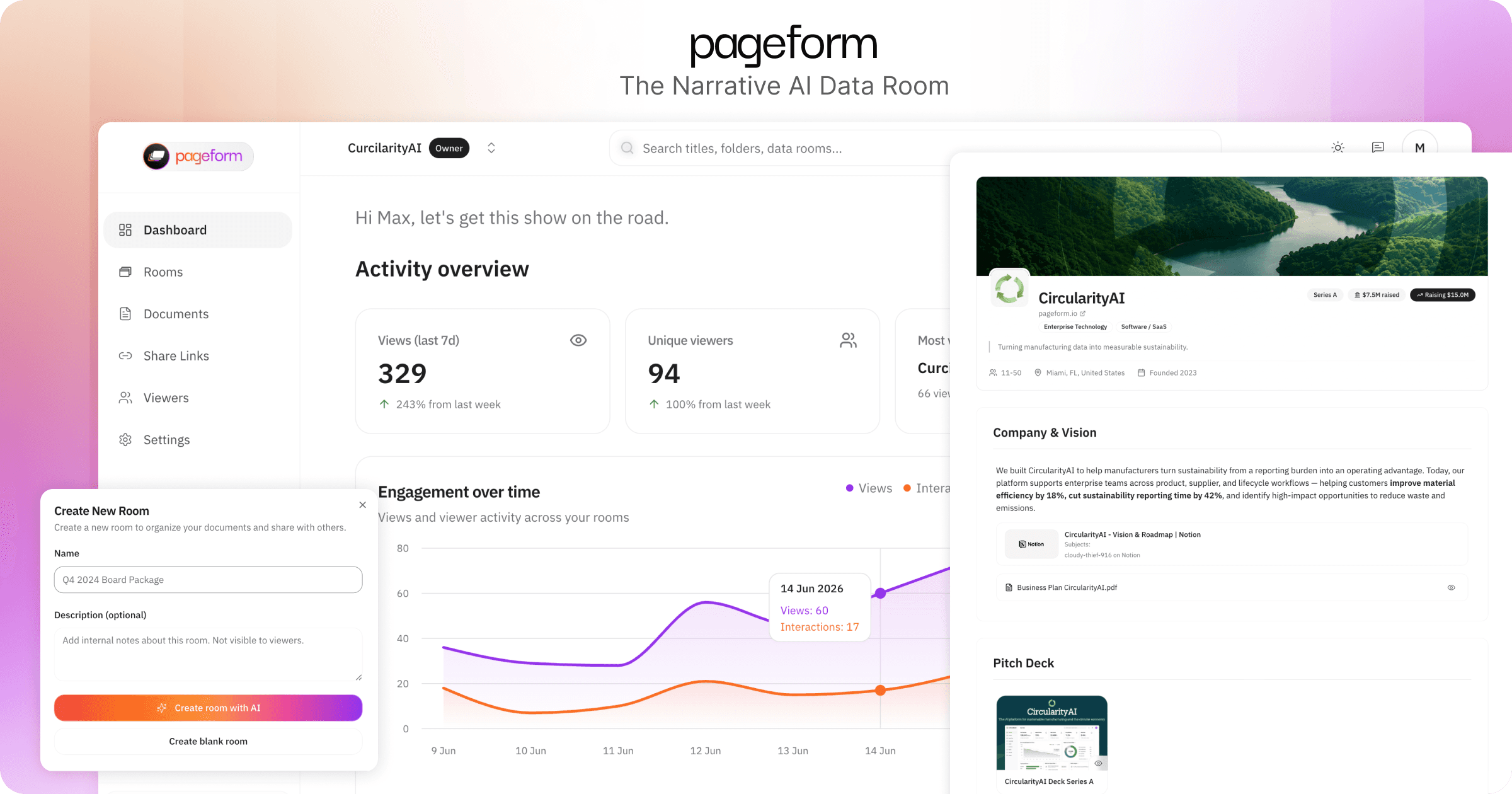
Florida's funding chain is filling in, and more founders will be in front of real investors sooner. When that moment comes, how you present decides how fast you close. A data room is not a folder. It is the first chapter of your story. Build yours with Pageform and be ready before the first check finds you.