The Emerging VC LP Reporting Playbook (2026)


Ksenia Moskalenko
Co-Founder @ Pageform | AI-native narrative data rooms for fundraising & deals

Your fund is not judged only on the quarter you close it. It is judged on every quarter after. LP reporting is the work that decides whether your Fund I backers wire again into Fund II, and most emerging managers treat it as an afterthought until a limited partner goes quiet. This playbook gives you the reporting cadence, the exact materials each period needs, and a way to run the whole thing from one controlled room instead of a mess of email attachments. If you send capital account statements late, bury the K-1, or write a letter with no numbers, you train your LPs to expect less. Do it well and reporting becomes your cheapest fundraising channel. Start with the calendar below, then build the room around it.
Why reporting is a fundraising problem, not an admin task
Emerging managers raise the next fund from the current fund's LPs. That is the whole game at Fund I and Fund II. Institutional LPs writing first checks are rare, so re-ups from your existing base carry the raise. Every report you send is a data point on whether you are a professional a large allocator can underwrite.
LPs are pattern matchers. They sit on ten, twenty, sometimes fifty fund relationships. The GP who reports on time, in a consistent format, with honest markdowns, stands out because so many emerging managers do not. When an LP considers a re-up, they do not reread your original pitch. They scroll their inbox and their portal for how you communicated over three years. Sloppy reporting is a silent no.
There is also a defensive reason. Clean, timely reporting is what an LP's own auditors and investment committee expect. When your LP is a fund of funds or an endowment, your capital account statement feeds their books. Late or inconsistent numbers create work for them, and work for an LP is friction you do not want attached to your name.
The reporting calendar every fund manager should run
Reporting has a rhythm. Map it once and it stops being a scramble. Here is the cadence most institutional LPs expect from a venture or growth fund.
Capital call notices, as needed. When you draw down committed capital, LPs need a formal notice with the amount, the due date, wire instructions, and the purpose. Give at least ten business days of lead time. Late or vague calls make LPs nervous about your controls.
Quarterly capital account statements, within 45 to 60 days of quarter end. This is the single most important recurring document. Each LP gets their beginning balance, contributions, distributions, allocated gains and losses, fees, and ending balance. It ties directly to the numbers they book internally.
Quarterly LP letter, same window as the statements. The narrative that sits on top of the numbers. What you deployed, what changed in the portfolio, what you are seeing in the market, and any honest bad news.
Annual audited financials, within 90 to 120 days of year end. Audited fund-level statements from your fund administrator and auditor. Institutional LPs treat unaudited annuals as a red flag.
Annual Schedule K-1 tax forms, targeted for March, realistically by the extension. Your LPs cannot file their own taxes without these. A late K-1 is the complaint that gets escalated to the LP's CFO.
Annual meeting or annual letter, once a year. A deeper review of the whole portfolio, fund performance against benchmarks, and your forward strategy. This is where re-up conversations quietly begin.
If you only fix one thing this year, fix the 45-to-60-day quarterly close. Consistency on that single deadline signals operational maturity more than any deck you send.
What actually goes in a strong quarterly report
A weak quarterly report is a two-line email that says the fund is doing well. A strong one gives an LP everything they need to update their own model and defend the position to their committee. Include these.
Fund-level performance metrics that LPs can benchmark: TVPI, DPI, RVPI, IRR, and paid-in capital as a percentage of commitment. Do not invent a proprietary metric to look better. LPs compare you against every other fund they hold, so use the standard set.
A portfolio company summary with real signal. For each material position, give the stage, your entry, the current mark, the basis for that mark, and a one-line status. Note new financings, up rounds, down rounds, and any write-offs. LPs respect a GP who marks honestly more than one who marks optimistically and reverses later.
The capital account statement for that specific LP, personalized to their commitment. This is not the same file for everyone. Each LP sees only their own position.
A clear-eyed narrative. Cover deployment pace, reserve strategy, what you passed on and why, and the current fundraising environment for your companies. If a company is struggling, say so before the LP hears it elsewhere. Bad news delivered early is credibility. Bad news discovered late is a broken relationship.
Fee and expense transparency. Show management fees charged and offsets applied. Fee surprises are one of the fastest ways to lose an LP's trust.
The failure scenarios that cost emerging managers re-ups
These are the specific ways reporting goes wrong. Each one is avoidable.
The silent quarter. You had a slow deployment quarter, so you skipped the letter. The LP notices the gap and reads it as either disorganization or something being hidden. Report every quarter, even the quiet ones. A short honest update beats silence.
The inconsistent format. Q1 is a PDF, Q2 is a Google Doc link, Q3 is text in an email body. The LP cannot track your fund over time because nothing lines up. Pick one structure and repeat it exactly. Boring and consistent wins.
The buried tax form. You send the K-1 as one attachment in a long thread in April. Half your LPs miss it and email you in a panic near the filing deadline. Deliver tax documents in a predictable place every year, and tell LPs exactly where to find them.
The forwarded confidential file. An LP forwards your quarterly letter, with another LP's capital account details attached, to their spouse or advisor. Now you have leaked one investor's position to an outside party. Personalized documents and controlled access prevent this. Blanket email attachments do not.
The version you cannot prove. A dispute comes up about what you reported and when. You are digging through sent mail trying to reconstruct the timeline. A room with a clear record of what was shared and when removes the argument entirely.
How to run reporting from one controlled room
Email attachments are where LP reporting quietly breaks. Files get forwarded, versions drift, and you have no record of who opened what. A reporting room fixes the structural problems that email cannot.
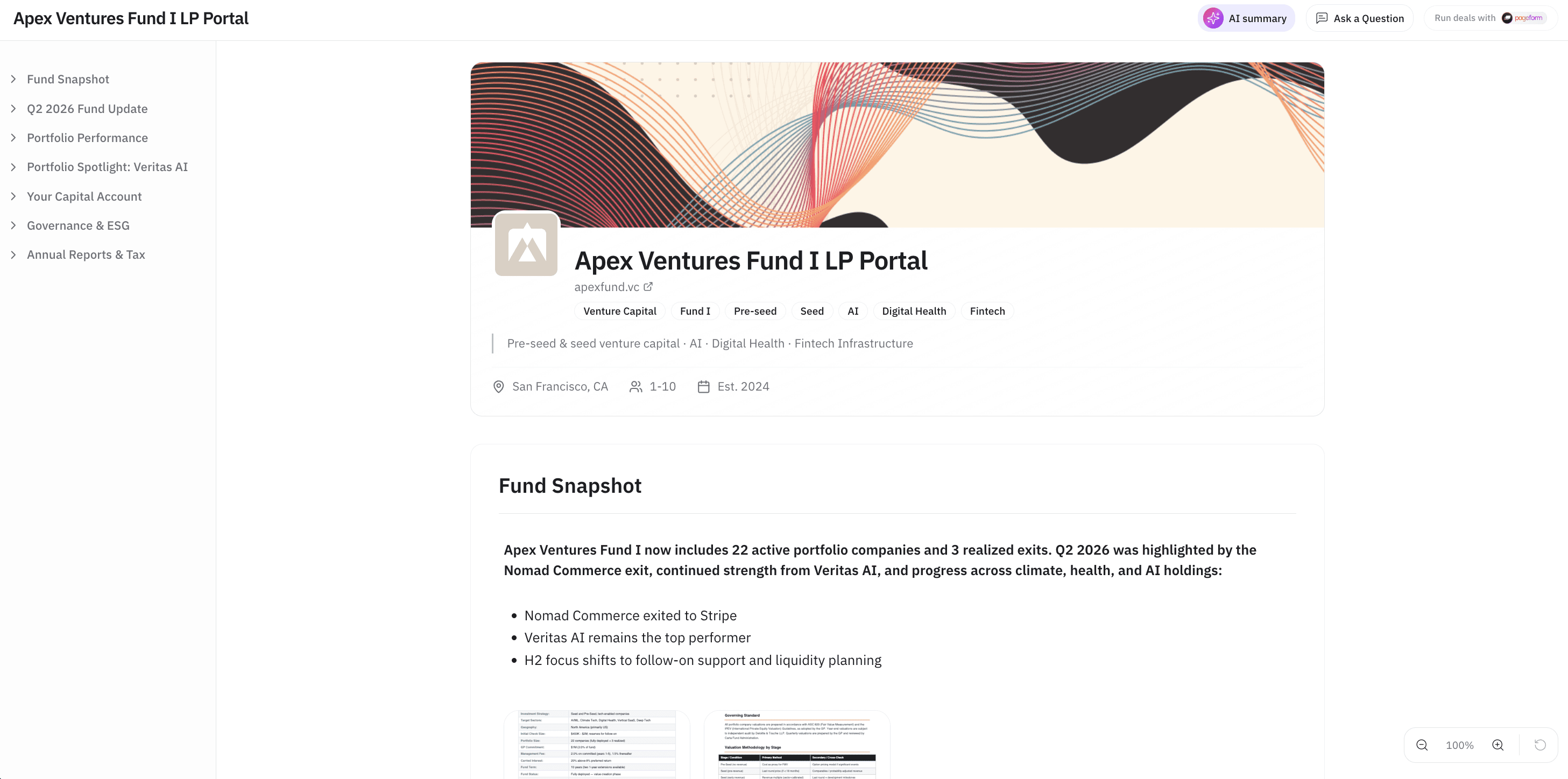
Set up a persistent investor room for the fund, with a stable section for each reporting period. LPs learn where things live and stop emailing you asking where the Q2 statement is. Pageform is an AI-native, narrative-driven data room designed for fundraising, sales, and partnership deals, and the same structure that holds a raise together also holds ongoing reporting together across the life of the fund.
Use granular permissions so each LP sees fund-level materials plus only their own capital account statement, never another LP's position. This is the single most important control in LP reporting and the one email cannot enforce.
Gate access properly. New LPs, advisors, and fund administrators should enter through controlled access, not a link that gets pasted around. If you want the reasoning behind gating and permissioned sharing, our guide to building an investor data room covers the structure in depth, and it applies to reporting rooms as much as to raise rooms.
Watch engagement as a relationship signal. When you post a quarterly letter, you want to know who read it and who did not. An LP who never opens your reports is an LP drifting toward a no on the re-up, and you want that signal months early, not at the fundraise. Page-level analytics tell you which parts of the report held attention and which got skipped, which is why page-level document analytics matter for reporting and not just for pitching. For the mechanics of reading those signals, see how to track investor engagement in your data room.
Keep the audit trail. A room records what you shared and when. That record protects you in any dispute and demonstrates the operational discipline institutional LPs underwrite. The same discipline that private equity firms bring to diligence rooms belongs in your LP reporting.
A 30-day plan to fix reporting before your next quarter close
You do not need to rebuild everything at once. Run this over the next month.
Week one, map your calendar. Write down every reporting obligation in your LPA and your side letters. Note the deadline for each. Many emerging managers have never listed these in one place, and side letters often add reporting terms the main document does not.
Week two, standardize the templates. Build one quarterly letter template and one capital account statement format with your fund administrator. Lock the structure so every future quarter matches. Consistency is the goal, not polish.
Week three, stand up the room. Create the persistent investor room, set per-LP permissions, and load the last two quarters so LPs have history in one place. Test that each LP can see their own statement and no one else's.
Week four, communicate the change. Send one short note telling LPs where reporting now lives and what cadence to expect. Setting the expectation is half the credibility. Then hit your next quarterly deadline exactly, and keep hitting it.
Reporting is not glamorous, but for an emerging manager it is the most leveraged relationship work you do between funds. Get the cadence right, run it from a controlled room, and your reports stop being an obligation and start being the reason your LPs come back.
Frequently asked questions
How often do LPs actually expect reports from an emerging fund?
Quarterly for capital account statements and a letter, annually for audited financials, K-1s, and an annual meeting or letter, and ad hoc for capital call notices. The exact terms live in your LPA and side letters, so start there. Quarterly reporting within 45 to 60 days of quarter end is the market standard most institutional LPs assume.
What is the difference between a capital account statement and the quarterly letter?
The capital account statement is the numbers for one specific LP: their contributions, distributions, allocated gains and losses, fees, and ending balance. The quarterly letter is the narrative for all LPs: deployment, portfolio changes, marks, and market context. You need both. Numbers without a narrative feel cold, and a narrative without numbers feels evasive.
Do I need a fund administrator, or can I report myself?
Most institutional LPs expect a third-party fund administrator and an annual audit, because independent numbers are more credible than GP-prepared ones. You can handle the narrative letter and the reporting room yourself, but the capital account statements and audited financials should come through your administrator and auditor.
Why not just email reports as attachments?
Email cannot enforce that each LP sees only their own capital account details, cannot stop a confidential file from being forwarded, and gives you no record of who opened what. A permissioned reporting room solves all three, and the engagement signals also tell you which LPs are drifting before a re-up conversation.
How does reporting connect to raising my next fund?
Directly. Emerging managers raise the next fund mostly from current LPs, so three years of clean, on-time reports are your re-up case. When you open your next raise, you want that reporting room and its track record ready. Our breakdown of data rooms for emerging fund managers raising from LPs covers the raise side once the reporting foundation is in place.
What should I fix first if I am behind on reporting?
The quarterly close. Commit to sending capital account statements and a letter within 60 days of quarter end, in one consistent format, every quarter without exception. That single habit signals more operational maturity to an LP than any other change you can make.
Run your LP reporting from one controlled room your investors actually trust. See how Pageform structures investor rooms and reporting.