What Is Missing From Your Fundraising Data Room?


Artem Axelrod
Co-Founder @ Pageform | AI-native narrative data rooms for fundraising & deals

What Is Missing From Your Fundraising Data Room?
12 Gaps Investors Notice Fast
Last updated: September 6, 2026
A fundraising data room can look complete and still be missing the exact evidence an investor will ask for next. The obvious gaps are easy to spot: no financial model, no cap table, no legal documents.
The more dangerous gaps are subtler.
Your deck says retention is improving, but there is no cohort data. Your use-of-funds slide promises 18 months of runway, but the model shows 12. Your traction section highlights a large pipeline without explaining stages or conversion assumptions. Those are the gaps that create extra questions, slow diligence, and weaken confidence. Before sharing your room, audit it against one simple standard:
For every important claim, is the supporting evidence easy to find, current, and consistent?
Here are 12 gaps worth checking.
1. The pitch makes claims the data room cannot prove
Start with your pitch deck and work claim by claim.
If you say revenue is accelerating, investors should be able to inspect the underlying numbers. If retention is a strength, include retention or cohort evidence. If the market thesis depends on a major shift, provide supporting research or context.
The data room should not simply repeat the pitch. It should make the pitch verifiable.
This is one reason the deck and room should follow the same narrative. Our guide on building one investor narrative from pitch deck to data room covers that structure in more detail.
2. Your numbers disagree across documents
Few things create unnecessary diligence faster than conflicting metrics.
Common examples include:
ARR in the deck differs from ARR in the financial model
Customer counts differ between the pitch and KPI report
Burn or runway uses different dates
Pipeline totals use different definitions
Ownership percentages do not match the latest cap table
Sometimes both numbers are technically correct because they use different dates or definitions. That context needs to be explicit.
Before sharing the room, decide which document is the source of truth for each key metric and reconcile anything that appears inconsistent.
3. Your financial model has numbers but no explanation
Uploading a spreadsheet is not the same as explaining the business.
Investors need to understand what drives the forecast.
That usually means making the major assumptions clear: growth, pricing, hiring, gross margin, burn, runway, and the milestones the raise is meant to finance.
A useful Financials section gives the investor context before the model itself.
The goal is not to explain every cell. It is to make the assumptions that actually matter easy to understand and challenge.
4. The cap table is outdated
A cap table that predates the latest SAFE, option grant, or financing can create confusion immediately.
Check that the room reflects the current ownership structure and that any relevant SAFEs, convertible notes, warrants, or option pool changes are accounted for.
If something has not closed yet, label it accordingly instead of presenting a hypothetical structure as current.
For sensitive ownership and financing materials, use appropriate secure document sharing and access controls rather than exposing everything to every viewer by default.
5. Your use of funds does not connect to milestones
“Hire sales and invest in product” is not a financing plan.
Investors want to understand what the round actually buys.
If you are raising $2 million, connect that capital to concrete operating assumptions and milestones. For example: key hires, product releases, revenue targets, market expansion, regulatory work, or runway.
Then make sure those claims agree with the financial model.
If the deck says the round funds 18 months of runway but the operating model shows 12, investors will notice.
6. Traction is presented without the evidence behind it
Traction is often one of the strongest parts of a fundraising story, but founders frequently stop at headline metrics.
A stronger Traction section may include the evidence behind those headlines: revenue history, user growth, retention, cohorts, pipeline, customer concentration, usage, case studies, or signed agreements where appropriate.
Not every company needs every metric.
The standard is simpler:
Can an investor understand why the traction claim is credible?
A strong fundraising data room should make that evidence easy to move through without turning the room into a pile of spreadsheets.
7. Your GTM story stops at the strategy slide
“We will grow through outbound, partnerships, and content” is not enough once diligence begins.
Investors may want to see what is already working.
Depending on the company, that could mean pipeline data, funnel conversion, sales cycle, CAC, channel performance, expansion behavior, or customer acquisition experiments.
The gap to look for is between the GTM story you tell and the GTM evidence you can show.
If the strategy is still early, say that clearly. Early evidence is better than inflated certainty.
8. Product claims have no product proof
A product-heavy company should not force investors to understand the product entirely through slides.
If a demo, walkthrough, interactive artifact, screenshot, or live link makes the product easier to understand, put it where the product story lives.
Pageform rooms can combine files with video, HTML, images, and links, so investors can experience supporting material in context instead of leaving the room to hunt for it.
The product section should answer both:
What does it do?
and
Can I see enough evidence to believe it works?
9. Your legal and corporate basics are incomplete
Legal diligence tends to become more important as an investor moves deeper into the process.
Depending on stage and round, common materials may include incorporation documents, financing agreements, IP assignments, material customer or vendor agreements, board approvals, employment documentation, and other corporate records.
The exact requirements vary.
The mistake is waiting until an investor requests something obvious before discovering that it is missing, unsigned, outdated, or sitting in someone else's inbox.
Do a basic corporate document inventory before serious diligence begins.
10. Important files are current, but the investor cannot tell which version is current
“Financial Model Final.xlsx.”
“Financial Model Final 2.xlsx.”
“Financial Model FINAL Sept.xlsx.”
This is not a minor housekeeping problem.
Multiple versions create uncertainty about which document the investor should trust.
Remove obsolete copies from the investor-facing room, use clear dates or version names, and keep one approved current version wherever possible.
Your internal workspace can contain drafts. The shared room should not make investors solve version control.
11. The room has documents but no context
A complete data room can still be difficult to understand.
A folder called “Financials” with six files makes the investor open each one and determine what matters.
A structured Financials section can first explain the key numbers, assumptions, and context, then provide the supporting documents.
That principle applies across the room.
The best structure is not necessarily the one with the most folders. It is the one that reduces the amount of reconstruction an investor has to do.
Pageform's AI Agent can generate a structured first-pass room from existing materials and help refine the narrative around them.
12. You have not checked the room from the investor's side
Before sharing, open the room as an external viewer.
Test the entire experience.
Can you find the important information quickly? Do the links work? Are documents loading correctly? Are access restrictions appropriate? Is confidential information gated? Do videos and other embeds work? Does the room make sense on mobile?
Most importantly, ask:
If I knew nothing about this company beyond the pitch, what would confuse me here?
That question often reveals gaps that are invisible when you have been living inside the materials for months.
How to audit your fundraising data room before investors do
A useful audit is not just a checklist of files.
Start with the claims your company is making and map them to evidence.
For each major claim, check:
Claim → supporting evidence → current source → consistency → investor access
Then look for four kinds of problems:
Missing: the evidence does not exist in the room.
Outdated: the right document exists, but it is stale.
Inconsistent: multiple documents tell different versions of the story.
Unclear: the evidence is present, but the investor has to work too hard to understand it.
This approach is more useful than checking whether every folder contains something.
A full walkthrough is available in our guide to using AI to organize and audit a fundraising data room.
How Pageform can help identify data room gaps
Pageform is an AI data room agent for fundraising, diligence, and deals. It is built to help founders and fund managers build, audit, and run a data room with AI, not just store files inside one.
Upload the materials you already have and Pageform can generate the initial room structure, organize documents, add narrative context, flag gaps, and identify missing files.
The AI Agent can help you:
Check whether the room is complete
Identify missing documents or sections
Flag weak or unsupported areas
Suggest improvements to structure and narrative
Surface inconsistencies that may need review
Help keep the room current as diligence progresses
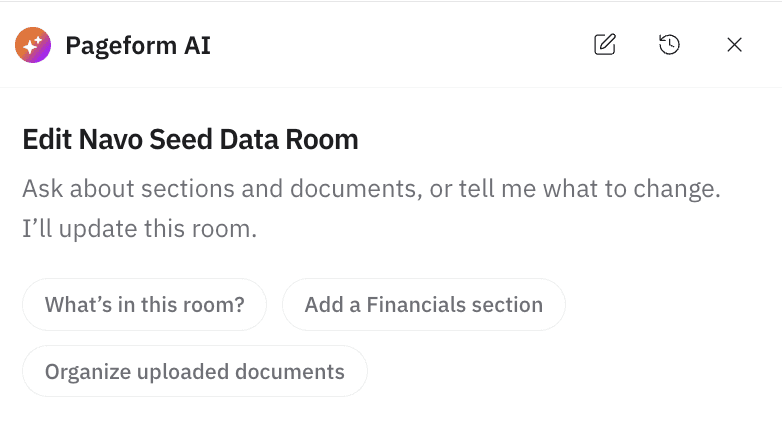
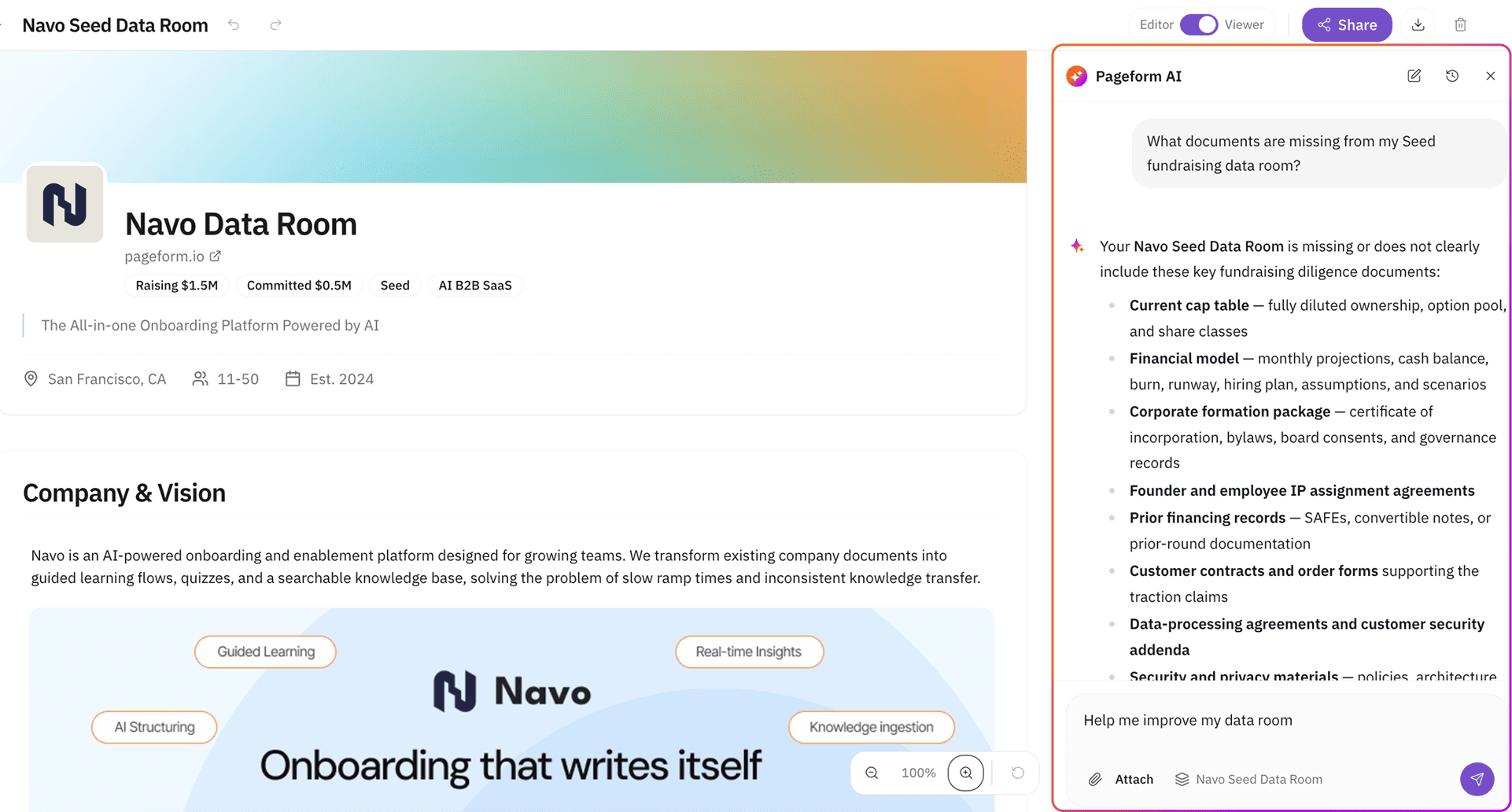
You can ask questions such as:
What is missing from my Seed fundraising data room?
Which claims in this room need stronger supporting evidence?
What should I improve before I send this to investors?
Are there sections of the room that look incomplete?
The goal is not to let AI make legal, financial, or disclosure decisions for you. Those still require founder, finance, and legal judgment.
The value is that Pageform can continuously review the room, surface gaps, and suggest what to improve before investors do.
And the job does not stop once the room is shared.
Pageform's investor engagement analytics show what viewers open, skip, revisit, download, and click, giving you another layer of feedback on what may need more context, stronger evidence, or a different structure.
That makes the data room a living diligence workflow rather than a static folder of files.
Frequently Asked (FAQ)
What is usually missing from a startup fundraising data room?
Common gaps include supporting evidence for claims in the deck, an updated cap table, clear financial assumptions, GTM evidence, current legal documents, customer or traction proof, and a clear explanation of how the raise connects to future milestones.
How do I know if my data room is investor-ready?
Check that important claims are supported, numbers agree across documents, current versions are clearly identifiable, sensitive materials have appropriate access controls, and an external viewer can understand the room without needing you to explain where everything is.
Can AI audit a fundraising data room?
AI can help inventory files, generate structure, identify possible missing materials, compare claims with supporting documents, and flag inconsistencies for review. Founders still need to verify factual accuracy, financial metrics, legal documents, and disclosure decisions.
Should I include every company document in my data room?
No. Include what is appropriate for the stage of diligence and useful for evaluating the company. More files can make a room harder to navigate and increase the risk of sharing outdated or irrelevant information.
When should I audit my fundraising data room?
Run an audit before opening serious diligence, whenever major materials change, and periodically during the raise. New financials, financing documents, traction, hires, or product updates can quickly make an otherwise complete room stale.
Find the gaps before diligence starts
The strongest data rooms do not simply contain more documents.
They make the company's claims easier to verify.
Before you share yours, check what is missing, outdated, inconsistent, or difficult to understand. Then make the path from claim to evidence obvious.