LP reporting: how emerging managers earn Fund II


Ksenia Moskalenko
Co-Founder @ Pageform | AI-native narrative data rooms for fundraising & deals

Last updated: September 23, 2026
LP reporting is not a chore, it is your next fund's first pitch
Most fund managers file their LP reports the way they file their taxes. It is an obligation, something the back office handles, a quarterly PDF that goes out because the LPA says it must. That belief is quietly expensive. The truth is that between funds, your reporting is the single most persuasive thing your LPs ever see from you, because it is the only evidence they have of how you actually behave once the money is wired. A great pitch gets you the first check. Great reporting gets you the second, the re-up, and the introduction to the next allocator. This piece takes apart the myth that LP reporting is administrative overhead, shows what it costs you, and lays out how to run reporting as the highest-leverage fundraising activity you have, including how an AI-native room changes the work.
The myth: reporting is compliance, the raise is sales
Ask most emerging managers where fundraising happens and they will point at the raise. The deck, the meetings, the data room, the first close. Everything after the wire gets filed under operations. Reporting becomes a deadline to survive rather than an opportunity to use.
This split feels natural because the two activities look different. The raise is loud and social. Reporting is quiet and administrative. One has a clear finish line, the other repeats forever. So managers pour their energy into the pitch and hand reporting to whoever has time, or to a template that has not changed in three funds.
The split is also wrong, and it is wrong in a way that costs real money. LPs do not experience your fund as a raise followed by silence. They experience it as a decade-long relationship in which the reports are almost the entire relationship. You meet them a handful of times. You send them reports many times. By the time you raise your next fund, the impression they carry is built far more from how you reported than from how you pitched.
What the chore mindset actually costs
Treating reporting as overhead does not just leave value on the table. It creates specific, avoidable damage.
The first cost is the re-up you do not get. LPs decide whether to back your next fund long before you ask. They decide it quarter by quarter, watching whether your reporting is clear, honest, and on time. A manager who sends thin, late, inconsistent updates has already answered the re-up question, and the answer is no. You will not hear that no during the reporting years. You will hear it as silence when you open Fund II.
The second cost is the reference you cannot use. Your best fundraising asset for the next fund is an existing LP who will take a call and vouch for you. That LP only becomes an advocate if the experience of being in your fund was good, and most of that experience is reporting. A manager who communicates well between capital calls builds a bench of references. A manager who goes dark builds a list of people who are polite but will not pick up the phone for a new allocator.
The third cost is the trust discount on every hard moment. Funds have bad quarters. A markdown, a failed portfolio company, a slower deployment than planned. LPs forgive these when they trust you, and they trust you because your reporting has been steady and straight the whole time. The manager who only surfaces when the news is good has no credibility when the news is bad. Reporting is how you earn the benefit of the doubt before you need it.
The fourth cost is your own blindness. When reporting is a chore you push out and forget, you never learn whether anyone read it. You do not know which LPs are engaged and which have mentally checked out. You walk into your next raise guessing at your own base, when the data to rank it was sitting in front of you the whole time.
The reframe: reporting is a product, and LPs are the users
Once you stop seeing reporting as a filing and start seeing it as a product, the whole thing changes. A product has users with needs. It has a cadence. It gets better with feedback. And you can measure whether it is working.
Your users are not one audience. A family office reads differently from a fund of funds, and both read differently from a pension. Some LPs want the one-page summary and the number. Others want the full capital account detail and the portfolio company narratives. A reporting product serves all of them from the same underlying material, presented at the depth each one needs, rather than forcing everyone through the same undifferentiated PDF.
A product also has a rhythm you can commit to and keep. The managers who build trust are not the ones who write the most beautiful letter once. They are the ones who show up on the same schedule every quarter, so LPs learn they can rely on you. Predictability is itself a signal of operational quality, and LPs read it as one.
And a product can be measured. You can see which LPs open what, how long they spend, and where they stop. That turns reporting from a broadcast into a feedback loop, and the feedback is worth more than most managers realize.
The reporting operation, quarter by quarter
Here is what a reporting operation looks like when you run it as the fundraising engine it is. Treat each element as part of the product, not a box to tick.
The quarterly letter is your voice. It is where you tell LPs what happened, what you did about it, and what you are watching. Write it straight. Report the marks that went down as clearly as the ones that went up, because the LP who catches you burying a markdown will never fully trust a report again. A short, honest letter beats a long, evasive one every time.
The capital account statement is your precision. LPs use it to reconcile their own books, so the numbers have to tie out exactly, every period, across every document. The standard metrics an LP underwrites on, the distributions to paid-in, the total value to paid-in, the net internal rate of return, should be consistent wherever they appear. Nothing erodes confidence faster than a multiple that reads one way in the letter and another in the statement.
The capital call and distribution notices are your operational proof. They are transactional, but they are also the moments an LP feels your machine working or failing. A clean, timely, well-formatted notice says the fund is run by people who have their act together. A confusing or late one says the opposite, and LPs remember it.
The portfolio update is your judgment on display. This is where LPs see how you think about your companies, which ones you are leaning into, which ones you are worried about, and why. It is the closest thing to watching you work. Managers who write these well are effectively pitching their next fund every quarter, because they are proving they can pick and steward.
The annual package is your accountability. Audited financials, the annual meeting materials, the year in full. This is where a serious LP does their deepest read, and where the gaps in a sloppy reporting year all come due at once. If the quarters were clean, the annual is a formality. If they were not, it is a reckoning.
Tier the room, do not blast the PDF
A single PDF emailed to every LP is the chore mindset made visible. It overexposes some information and underserves other readers, and it gives you no control and no signal.
A better model is a structured, permissioned reporting room. Each LP gets access to their own capital account and the fund-level materials, and nothing they should not see. An anchor doing deep confirmatory work for a re-up can be shown more. A small early check gets the clean summary. You present the same underlying truth at the right depth for each relationship, and you do it from one place you keep current instead of a dozen email threads with attachments drifting out of version.
This also fixes the version problem that plagues email reporting. When a number gets restated or a document gets corrected, you update once and every LP sees the current version at the same link. No LP is quietly working from a stale attachment they downloaded two quarters ago. The gaps that investors notice fast in a raise are the same gaps that erode trust in reporting, and our breakdown of what tends to be missing before a room goes out applies just as well to a reporting package as to a fundraising one.
Read engagement, because it is your next raise ranked
This is the part the chore mindset throws away entirely, and it is the most valuable. When your reporting lives in a room rather than an inbox, you can see how each LP actually engages with it.
You learn which LPs open every report within a day and read to the end, and which have not opened one in three quarters. You learn who spends real time on the portfolio update and who only checks their own statement. That behavior is a live ranking of your own base for the next fund. The LP who reads everything, returns to it, and clicks into the detail is telling you they are still with you. The one who stopped opening is telling you something too, and you want to know it now, not when you send the Fund II deck into silence.
Use the signal to act while it matters. When an engaged LP goes quiet after a run of activity, that is a moment for a call, not a form email a month later. When several LPs cluster on the same portfolio company or the same line in the letter, that topic is either your strongest story or your biggest worry, and you should know which before they raise it. The same engagement logic that lets managers read investor interest during a raise works between funds too, and between funds is exactly when most managers fly blind.
Where an AI-native room changes the work
The honest objection to all of this is time. Reporting done well is a real workload, and emerging managers are running lean. This is where the tooling matters, and where an AI-native room is different in kind from a legacy data room that only stores files and logs downloads.
With Pageform's AI Agent, which builds a room from a prompt and your materials, you describe the reporting package and attach your raw inputs, the draft letter, the statements, the portfolio notes, and it assembles a structured reporting room you keep refining in the same chat. Instead of rebuilding the layout every quarter, you start from a working draft and adjust it. For a manager sending to dozens of LPs, that first pass is hours back every reporting cycle.
The audit step is the one managers should not skip. Before any LP sees the package, ask the agent to review the room for gaps, the missing capital account line, the metric that does not reconcile across documents, the portfolio update that references a company with no accompanying detail. Finding that yourself costs nothing. Having an LP find it costs you a piece of the trust you are trying to build. The same room audit that catches holes before a raise catches them before a report.
The agent can also answer questions about the room's contents, so when an LP or your own investor relations team needs a specific term or figure, they can query the documents directly instead of waiting on an email thread. Faster answers between capital calls are a quiet, compounding trust builder. To be clear about scope, the agent structures, audits, answers questions about, and reads engagement on the materials you provide. It does not replace your fund administrator or your auditor. It removes the assembly and the busywork, not the accounting or the judgment. AI Agent usage runs against your plan's AI credits, and the Pageform pricing page lays out what each tier includes.
Pageform is an AI-native data room designed for fundraising, sales, and partnership deals, and ongoing LP reporting sits squarely inside that scope. If you run real assets as well as a fund, the same approach carries over, and our real estate investor reporting playbook covers the property side of the same discipline.
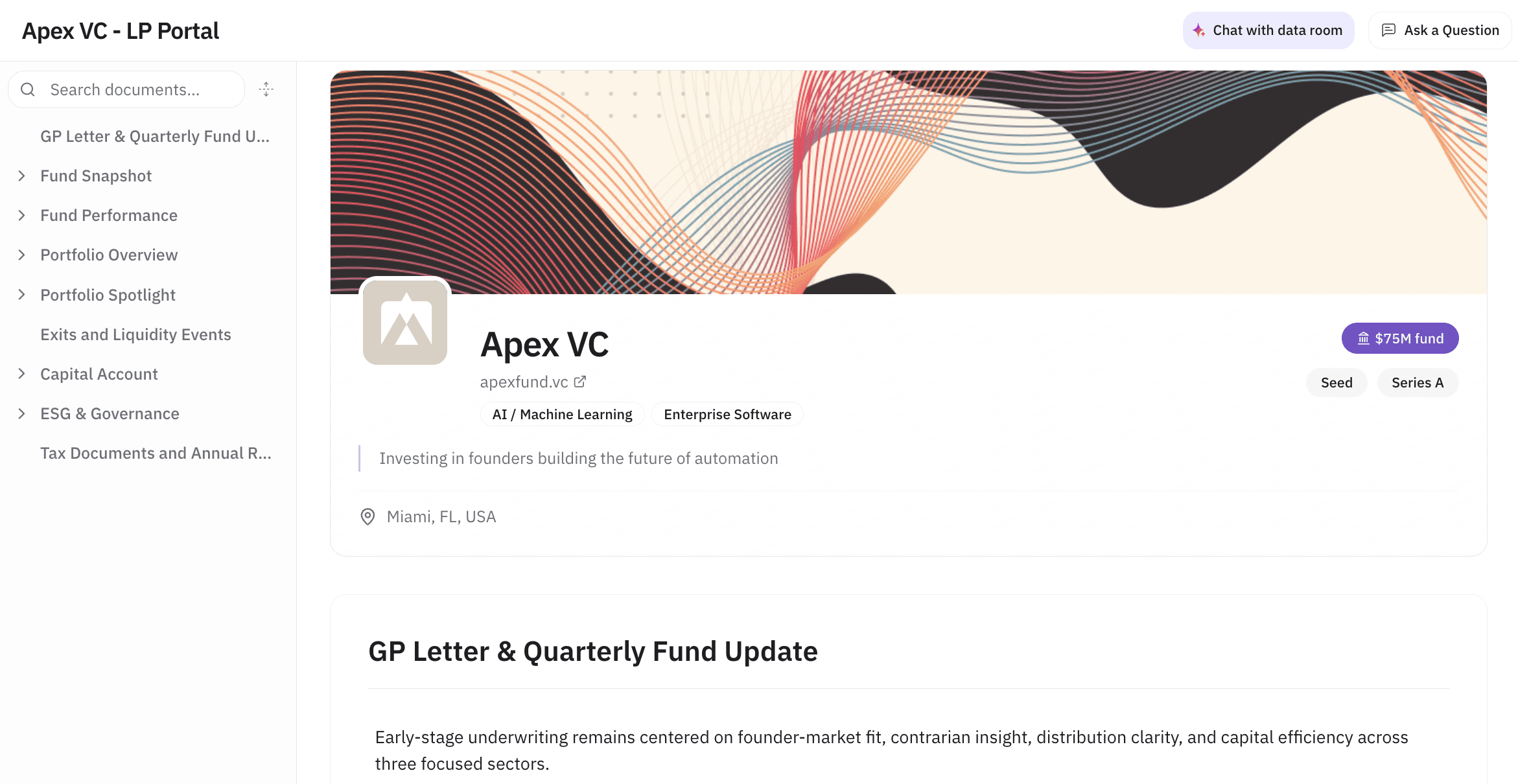
Explore a sample LP Reporting Data room built on Pageform here.
The compounding return of reporting well
The reason to reframe reporting is not tidiness. It is compounding. Every quarter you report clearly and honestly, you add to a store of trust that pays out when you raise again. LPs who had a good experience re-up, and they re-up faster and with less diligence because they already know how you operate. They also refer, and a warm referral from a happy LP is worth more than any cold outreach.
The manager who treats reporting as a chore starts every raise close to cold, even with existing LPs, because the reporting years did nothing to deepen the relationship. The manager who treats reporting as a product starts every raise warm, with a base that already trusts the machine and references who will vouch for it. Same fund, same returns, very different fundraise. The difference was made in the quarters nobody thought were fundraising.
Frequently Asked Questions (FAQ)
What should be in a fund's quarterly LP report?
A clear and honest quarterly letter, a capital account statement for each LP with metrics that tie out across every document, capital call and distribution notices as they occur, and a portfolio update that shows your judgment on the companies. The annual package adds audited financials and the annual meeting materials. LPs read their own statement and the portfolio narrative most closely, so make both easy to find and consistent with the letter.
How is fund LP reporting different from a startup investor update?
A founder update is a short, momentum-building note to many small investors. Fund LP reporting is an institutional obligation to fiduciaries who hold your capital for a decade and will underwrite your next fund on how you handled this one. The document set is larger, the numbers must reconcile precisely, and the audience reads more critically. The cost of a sloppy report is higher because it directly shapes the re-up decision.
How often should I report to LPs?
Follow what your LPA requires as the floor, which is typically quarterly reporting with an annual audited package, plus call and distribution notices as they happen. The managers who build the most trust are not the ones who report most elaborately. They are the ones who report on a predictable cadence and never go dark, because reliability itself signals operational quality.
Can reporting really help me raise my next fund?
Yes, and it is often the deciding factor for existing LP re-ups. Allocators decide whether to back your next fund quarter by quarter, based on whether your reporting is clear, honest, and on time. Good reporting also earns you references, and a warm reference from a satisfied LP is one of the strongest assets in a new raise. The reporting years are when the next raise is quietly won or lost.
How does an AI-native room help with LP reporting specifically?
It assembles a structured reporting room from the materials you attach, audits that package for gaps before LPs see it, answers questions about the documents directly, and reads how each LP engages with the reports. That replaces manual layout work and blind email attachments, and it gives you a live view of which LPs are still with you. It does not replace your fund administrator or auditor. It removes the assembly and surfacing work, not the accounting.
What engagement signals matter most in LP reporting?
Watch three. Consistency, meaning which LPs open every report versus which have gone quiet for several quarters. Depth, meaning who spends real time in the portfolio update and the detail rather than only glancing at their statement. And clustering, meaning when several LPs focus on the same company or the same line, which flags either your strongest story or your biggest risk. Together these rank your base for the next raise before you ask.
Turn your reporting into the engine for your next fund
Stop filing LP reports and start running them as the highest-leverage fundraising you do. Report straight, keep a predictable cadence, tier the room so each LP sees the right depth, and read engagement so you know who is still with you. If you want to see how an AI-native room assembles, audits, and reads an LP reporting package, start with Pageform and make the quarters between funds work for your next raise.