Ansarada Review 2026: Strengths, Limits, and Fit

Artem Axelrod
Co-Founder @ Pageform | AI-native narrative data rooms for fundraising & deals

The short verdict
Ansarada is one of the most capable virtual data rooms built for serious M&A. It is a full-lifecycle transaction platform, not a simple file share, with a security posture that large deals demand. If you run cross-border sell-side processes, complex diligence with hundreds of thousands of documents, or bidder Q&A at scale, it earns its place on the shortlist.
It is also heavy, and priced for that weight. Smaller teams and simpler raises often pay for capability they never use, and the pricing is quote-based rather than transparent. This review covers what Ansarada does genuinely well, where it falls short in specific ways, and which deals it fits. It is written for M&A advisors, corporate development, and deal teams choosing a room, not for a vendor's homepage.
Who Ansarada is built for
Ansarada is aimed at the deal end of the market. Think sell-side advisors running an auction, corporate development teams managing acquisitions, and PE deal teams handling diligence with many bidders and many documents. Its heritage is M&A, and the product reflects that. It assumes a real transaction with a real Q&A process, multiple parties, and a diligence index that has to hold up under pressure.
That focus is a strength and a filter. If your deal looks like that, Ansarada speaks your language. If your deal is a seed raise, an LP update, or a sales room with a handful of documents, you are looking at a tool built for a bigger job than you have.
What Ansarada does genuinely well
The AI suite is the real story now, and it is not a single chatbot. Ansarada has spread AI across the actual diligence workflow.
AI-Sort automatically organizes uploaded documents into a logical diligence index. For a deal team that would otherwise index thousands of files by hand, that cuts real setup time. AI-Redact bulk-redacts personally identifiable information across many documents at once using pattern recognition, which matters when you are cleaning a large file set before buyers see it. AI-Translate handles document translation across more than a dozen languages, which is genuinely useful on cross-border deals where you would otherwise wait on external translators.
Then there is Ask Aida, Ansarada's conversational assistant. It lets a user query document contents in natural language and returns sourced answers with citations, and the company states that data does not leave the secure room. Recent 2026 updates add PDF summaries, extraction of parties, dates, and monetary values, and context-aware help that drafts Q&A responses using earlier information. For a buy-side team reading into an unfamiliar business, that is a fast way to find the clause that matters.
Ansarada also markets AI-Predict, which it says analyzes behavioral data from tens of thousands of past deals to forecast bidder engagement and outcomes early in a process. Treat the specific accuracy figures as the vendor's own claim rather than an independent result, but the underlying idea, reading engagement to gauge which bidders are serious, is sound and valuable in a competitive process.
Beyond AI, two things come up again and again from users. Security is consistently cited as a core strength, which is what you want when the documents are a live transaction. And support is responsive and hands-on, which counts for a lot when a deal is moving fast and something breaks at the wrong hour. The interface is also cleaner than the older enterprise VDR reputation suggests.
Where Ansarada falls short
No tool is the right answer for everyone, and Ansarada's weaknesses are specific.
Pricing is opaque and can climb. Ansarada does not publish full, flat pricing. It is quote-based and tiered, and reviewers repeatedly note that costs can become unpredictable, in thousands of dollars per deal, and expensive for smaller teams compared with flat-rate alternatives. If you want to know your number before a sales call, you will not find it on the page, so budget for a quote and check the current model on Ansarada's own pricing page before you commit.
It is too heavy for simple deals. The same depth that wins large M&A becomes overhead on a small one. Reviewers from smaller organizations describe the advanced feature set as overkill for basic use. If your process does not need bulk redaction, translation, and predictive bidder analytics, you are carrying weight you do not use.
The mobile experience trails the desktop. Despite updates, users still report that mobile UX lags. For a reviewer who lives in email and phone between meetings, that friction is real.
The Q&A workflow has rough edges. Some users note that when the other side bulk-uploads questions, the question IDs are assigned at random rather than in numerical order, which makes a large Q&A harder to track. On a busy auction that is exactly when order matters most.
Ansarada versus an AI-native data room
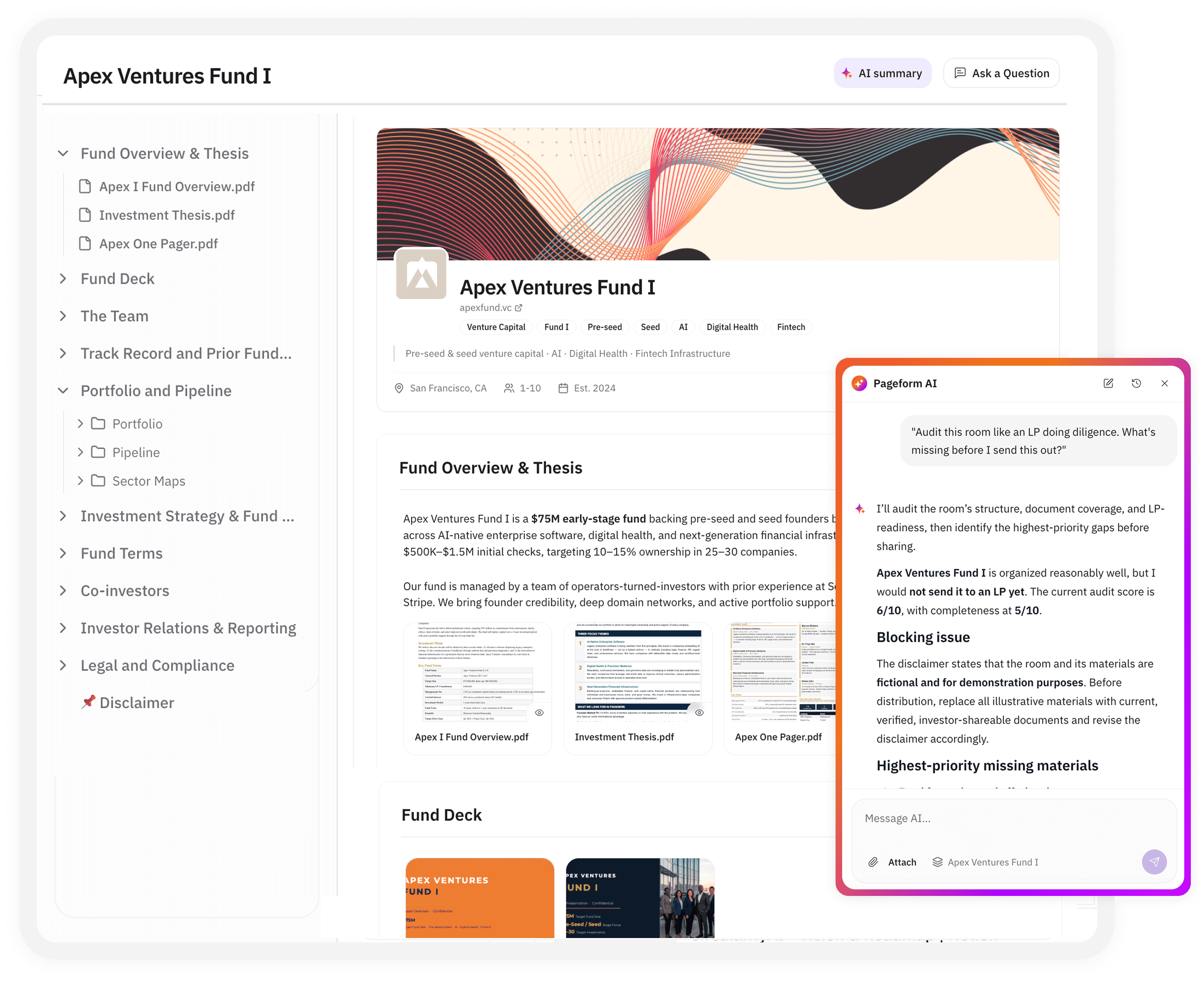
Ansarada and an AI-native data room like Pageform are not the same category, and picking between them is really about what your deal needs. The table below is an honest sketch, not a scoreboard.
What you need | Ansarada | AI-first room like Pageform |
|---|---|---|
Thousands of documents, bulk redaction, translation | Strong, purpose-built | Not the target use case |
Large multi-bidder Q&A and auction workflow | Strong | Lighter, better for focused audiences |
Structured story that guides a reader through the deal | Document-and-index led | Built around narrative and plug-and-play sections |
Build the room from a prompt and attached files | Limited AI sort & index | AI Agent drafts a custom data room from your files, identifies gaps and audits it |
Fast setup for a raise, LP update, boutique M&A or sales room | More than most such deals need | Built for exactly this |
Transparent, self-serve pricing | Quote-based | Published plans |
The honest read: for a complex, high-volume, multi-party transaction, Ansarada's depth is a genuine advantage and an AI-native narrative-driven tool is not trying to compete there. For a founder raising a round, a fund manager running Fund I, II, III raise or sending an LP update, or a team sharing a focused set of high-stakes materials, that same depth is friction, and a room that builds itself from a conversation and reads like a story fits better. If you want to see how a focused diligence room is structured on the sell side, our M&A sell-side room guide walks through it, and the buy-side due diligence request list covers what the other team will ask for.
Who should pick Ansarada, and who should look elsewhere
Pick Ansarada if your work is transactions at scale. Hundreds of thousands of files, cross-border M&A, large auctions, heavy redaction and translation, and a Q&A process with many parties are what it is built for, and it does them well. The AI suite and security justify the cost when the deal is big enough to need them.
Look elsewhere if your deal is smaller or your goal is communication, interaction, brand image and storytelling, not just diligence. A Seed, Series A, Series B+ raise, a venture capital fund's LP room, a real estate syndication, or a sales and partnership room does not need auction-grade tooling. It needs a room that tells the story, is fast to build and flexible to edit, easy for the other side to read, and clear about how people are engaging with it. That is a different job, and it is the one AI-first tools like Pageform are built for. If you are also weighing how engagement signals should inform your follow-up, our guide on tracking investor engagement in your data room is a useful companion.
The point of an honest review is to send you to the right tool, not to declare a single winner. Ansarada is very good at the job it was designed for. Make sure that job is your job before you pay for it.
FAQ
Is Ansarada a good data room for M&A?
Yes, for the deals it targets. Ansarada is built for M&A and shows it, with an AI suite for indexing, redaction, translation, and Q&A, strong security, and responsive support. For large or cross-border transactions with many documents and bidders, it belongs on the shortlist. For small raises or simple sharing, it is more than you need.
How much does Ansarada cost?
Ansarada does not publish full, flat pricing. It is quote-based and tiered, and some reviewers report costs rising for smaller teams. Check Ansarada's own pricing page for the current model, and ask for a written quote scoped to your deal size and duration before you commit.
What is Ask Aida?
Ask Aida is Ansarada's conversational AI assistant. It answers natural-language questions about the documents in a room and returns sourced answers with citations, and Ansarada states that data stays inside the secure room. Recent updates add PDF summaries, extraction of parties, dates, and values, and context-aware Q&A drafting.
What are Ansarada's main weaknesses?
Opaque and potentially rising pricing, depth that is overkill for simple deals, a mobile experience that trails the desktop, and a Q&A workflow where bulk-uploaded questions can receive non-sequential IDs. None are dealbreakers for large M&A, but they matter more the smaller and simpler your process is.
Is Ansarada the right choice for a startup raise or an LP fundraising data room?
Usually not. Those are communication jobs, not high-volume transactions. An AI-native narrative-first virtual data room that builds from a prompt, reads like a story, and publishes transparent pricing tends to fit a raise, an LP room, or a sales room better than an auction-grade platform.
Choosing a room for your next deal
Pageform is an AI-native, narrative-driven data room designed for fundraising, sales, and partnership deals. If your deal is about communicating a clear story to a focused audience, not running a thousand-document auction, describe it to the AI Agent and it builds, audits, and tracks the room for you. See plans on the pricing page or start for free at pageform.io.